The initial corporate hype surrounding artificial intelligence has officially settled. Businesses have realised that clicking onto a public web-browser chatbot to copy-paste data back and forth is a massive waste of operational time.
Today, true competitive advantage belongs to companies that embed computational intelligence directly into their own software.
Recent data indicates that nearly 80% of forward-thinking enterprises have shifted their focus from merely experimenting with AI to actively integrating it into their core workflows. For startups, e-commerce brands, and mid-sized enterprises, this shift is happening through Generative AI Integration Services.
But how does this technology actually work beneath the surface? Let’s pull back the curtain on the software engineering, pipelines, and data architecture that make seamless AI integration possible.
What is Generative AI Integration?
At its core, integration is the process of building a permanent, secure bridge between a powerhouse foundation model (like GPT-4, Claude, or specialised open-source models) and your company's existing digital infrastructure—such as your CRM, mobile apps, e-commerce storefront, or internal databases.
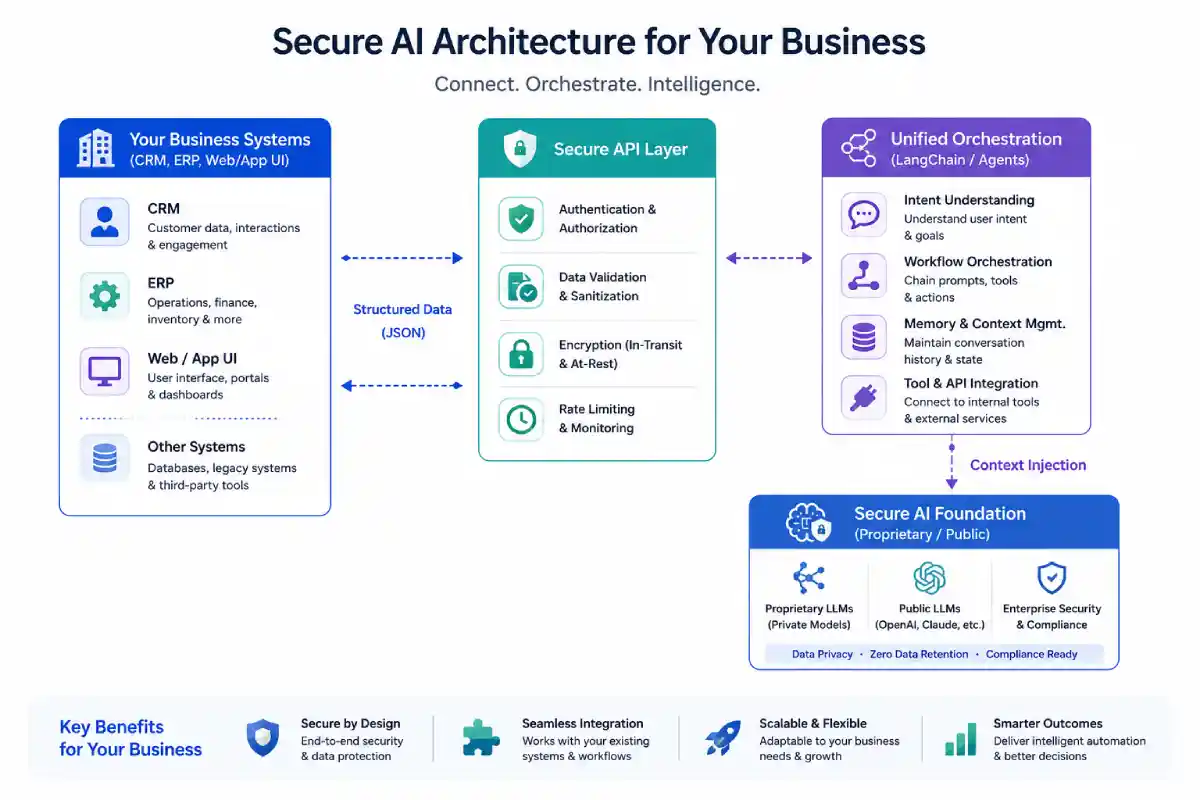
When you partner with a Leading Generative AI Development Company in India, the goal isn't just to fetch an API key. It is to construct an enterprise-grade ecosystem that translates chaotic human language into structured, safe, and highly accurate business actions.
The Core Blueprint: How the Integration Process Works
Turning a raw, general-purpose language model into a highly specialised corporate asset requires a precise, multi-step engineering pipeline. Here is exactly how it happens:
1. Architectural Strategy & Model Selection
Not all business problems require a multi-billion-parameter flagship model. AI architects first analyse your specific business goals to create a tiered infrastructure:
- Task-Specific Micro-Models: Lightweight, open-source models are integrated to handle lightning-fast, high-volume tasks like sorting support tickets or parsing basic contact forms at a fraction of the cost.
- Frontier Reasoning Engines: Heavyweight, complex models are called upon only when a task demands deep logical calculation, multi-step legal analysis, or complex creative synthesis.
2. Standardising the Tool-Calling Layer via MCP
Modern integration engineering relies heavily on open standards to avoid vendor lock-in. Developers increasingly utilise the Model Context Protocol (MCP), an open standard that allows application ecosystems to securely connect language models to external data repositories and operational systems.
MCP acts as an architectural translator. When a client interacts with your app, the orchestration framework safely converts their conversational query into clear, structural code blocks that your internal databases can understand without risking data corruption.
3. Contextual Injection via RAG (Retrieval-Augmented Generation)
A foundation model knows a great deal about general world history, but it knows absolutely nothing about your specific product SKUs, client contracts, or return policies. Integration services fix this using an architecture called Retrieval-Augmented Generation (RAG).
How RAG Operates in Real Time: When a customer asks your system a question, an internal search engine instantly scans your secure, private databases for the exact document paragraphs that contain the answer. It grabs those specific facts and hands them to the AI model alongside the user's question, forcing the AI to answer using only your verified business facts.
This completely eliminates data "hallucinations" and keeps your customer interactions grounded entirely in reality.
4. Constructing the Formatting & Middleware Layer
An AI model outputs raw conversational text. To make that text useful for an application, engineers write custom middleware that forces the AI to reply in structured code formats like JSON.
This is what allows an e-commerce platform to turn a chat conversation into an instant, live update to a user's shopping cart, or allows a fintech application to map an AI's text summary directly into a beautifully formatted financial dashboard.
5. Deploying Safety Guardrails and Anonymisers
Before any data leaves your system, strict governance layers are applied. Custom compliance code automatically scans outgoing data streams to strip out sensitive items like corporate passwords or personally identifiable information (PII), guaranteeing that your intellectual property stays completely within your corporate firewall.
The Four Pillars of Professional AI Engineering
When modernising a business tech stack, a premier Generative AI Development Company divides its deliverables across four distinct operational pillars:
|
Engineering Track |
Technical Focus |
Core Business Benefit |
|
Generative AI Integration Services |
Linking pre-trained foundation models directly to your web, mobile, and desktop applications. |
Delivers immediate, automated productivity gains inside the tools your team already uses daily. |
|
Generative AI Model Development Services |
Custom training, hyper-parameter tuning, and fine-tuning models on your proprietary datasets. |
Creates an exclusive intellectual property asset tailored to your unique industry niche. |
|
Generative AI Support Service |
Ongoing token cost optimisation, accuracy monitoring, prompt engineering updates, and security patches. |
Ensures your AI infrastructure never suffers from performance degradation or unexpected downtime. |
|
Governance & Regulatory Alignment |
Implementing end-to-end data encryption, audit logging, and compliance architecture (SOC 2, GDPR). |
Protects user privacy, mitigates legal risks, and builds profound customer trust. |
Real-World Impact: How Integration Scales Different Business Tiers
E-Commerce & Retail Brands
Instead of relying on clumsy, keyword-based search bars, integrated AI allows storefronts to comprehend exactly what a shopper is looking for. A customer can type, "I need a waterproof jacket suitable for a rainy European autumn under $150," and the system will instantly query real-time inventory, cross-reference weather tags, filter by price, and output a tailored list of recommendations alongside live checkout links.
Startups & Growing SMEs
For lean operations, integration serves as a permanent force multiplier. By embedding generative systems directly into their customer support and content pipelines, a small team can manage thousands of inbound inquiries, draft personalised email responses, and create highly targeted marketing collateral across multiple channels without needing to scale their overhead costs.
Large-Scale Enterprises
Enterprises leverage advanced Agentic AI frameworks to automate incredibly complex, multi-department workflows. For example, an integrated AI agent can independently receive an incoming supply-chain invoice, log into an internal legacy ERP system to verify the shipment, cross-check the pricing against an archived PDF contract, approve the transaction via your payment gateway, and send a summary update to management.
Why Align Your AI Strategy with Top-Tier Indian Developers?
Building custom, secure AI pipelines requires elite engineering talent and massive computational knowledge. Partnering with a Leading Generative AI Development Company in India offers significant tactical advantages:
- Pioneering Tech Infrastructure: Propelled by major initiatives like the National AI Portal of India, India's technological ecosystem has established massive computing hubs and localised model frameworks. These breakthroughs allow companies to process enterprise data workloads with remarkable speed and cost efficiency.
- Full-Stack Technical Symmetry: Top Indian engineering firms do not just build AI models in a vacuum. They offer comprehensive expertise, perfectly weaving your intelligent backend systems with clean web development, reactive mobile applications, secure databases, and comprehensive digital marketing strategies.
- High-ROI Scalability: Accessing highly specialised AI talent at an optimised global price point allows your business to invest heavily in deep customisation, extensive testing, and thorough training—maximising your software's long-term value.
Conclusion: Time to Future-Proof Your Architecture
Generative AI integration is no longer an optional luxury or a tech trend—it is the foundational architecture of modern business efficiency. By cleanly embedding artificial intelligence into your daily operational systems, you eliminate repetitive bottlenecks, protect valuable human resources, and unlock unforgettable experiences for your customers.
Take the leap toward intelligent automation. Collaborating with a proven, reliable Generative AI Development Company will ensure you deploy a safe, high-performing, and completely customised solution built to scale your business into the future.
6a60a6e873bfc.png)



0 Comments
Leave a comment