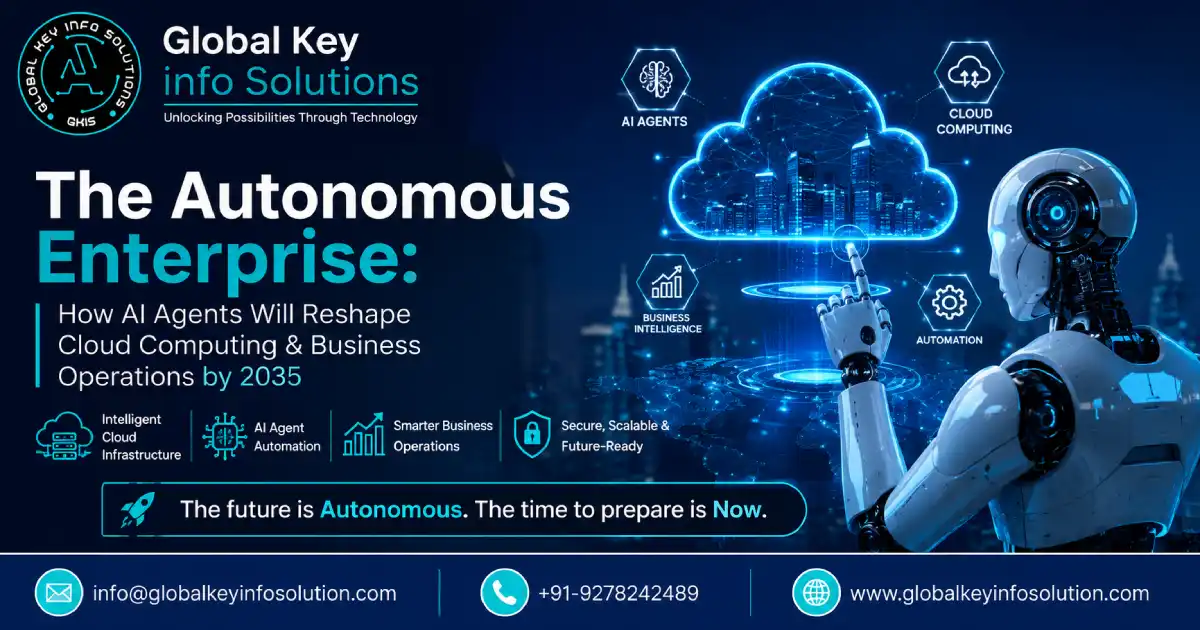
Imagine a cloud environment that can detect a server failure, identify the likely cause, and initiate recovery before users experience significant disruption. Or consider a supply chain where AI systems detect severe weather, evaluate inventory and transportation data, and recommend alternative routes automatically.
This is the direction in which AI agents, cloud computing, and business automation are evolving.
By 2035, enterprises may move significantly beyond today's AI assistants toward more autonomous systems capable of planning tasks, using software tools, coordinating workflows, and operating within predefined business rules.
However, the path to an autonomous enterprise will not happen overnight. Organizations need modern cloud infrastructure, connected data, strong cybersecurity, governance, and clearly defined human oversight.
What Are Autonomous AI Agents?
Traditional AI applications generally respond to a specific prompt or request. An autonomous AI agent goes a step further.
An AI agent can be designed to:
- Understand a defined business objective
- Break complex objectives into smaller tasks
- Use APIs and enterprise software
- Analyze real-time information
- Make decisions within predefined boundaries
- Coordinate with other agents or applications
- Report results and escalate high-risk decisions to humans
This creates a shift from AI as an assistant to AI as an operational system.
The concept is already influencing cloud-native and platform engineering discussions. CNCF research and community discussions in 2026 highlight the emergence of AI agents as consumers of enterprise platforms alongside developers and engineers.
1. From AI Assistants to Multi-Agent Systems
Today's AI assistants can help employees write content, analyze information, generate code, or answer questions.
The next stage is more sophisticated: multiple specialized agents working together.
For example, an enterprise could have:
- A monitoring agent analyzing infrastructure health
- A security agent detecting suspicious activity
- A FinOps agent analyzing cloud expenditure
- A customer-service agent managing support workflows
- A supply-chain agent monitoring inventory and logistics
- A software-development agent assisting with testing and deployment
Instead of every task requiring a human to move information from one application to another, agents could coordinate workflows through APIs and approved enterprise systems.
Humans would still define business objectives, policies, permissions, and escalation rules.
2. How AI Agents Could Transform Cloud Computing
Cloud infrastructure is becoming increasingly automated. AI agents could take this automation further by helping organizations monitor, optimize, and manage complex environments.
Self-Healing Cloud Infrastructure
A future cloud environment could continuously analyze logs, metrics, traces, and application behavior to identify anomalies.
For example, an agent might detect:
- Increasing application latency
- A failing service
- An unusual infrastructure pattern
- The likely root cause
- An approved remediation
Depending on the organization's policies, the agent could automatically execute a low-risk recovery procedure or request human approval for a more significant change.
This could make cloud computing services increasingly focused on resilience, observability, automation, and intelligent resource management.
Intent-Based Cloud Provisioning
Infrastructure management traditionally requires configuration files, deployment pipelines, policies, and technical expertise.
An intent-based approach changes the interaction.
Instead of manually specifying every infrastructure component, an engineer could define a goal such as:
"Deploy a highly available customer API with defined security, performance, and cost requirements."
AI-assisted infrastructure systems could then help translate that objective into approved infrastructure configurations.
The important point is that autonomy should operate within guardrails, rather than giving an AI unrestricted access to production systems.
Intelligent Cloud Cost Optimization
Cloud costs can change continuously based on workload demand, resource utilization, and infrastructure configuration.
AI agents could monitor these variables and identify opportunities to:
- Resize underutilized resources
- Schedule non-production workloads
- Detect unused infrastructure
- Recommend workload placement
- Forecast cloud spending
- Identify abnormal consumption
This makes AI-powered automation particularly relevant to FinOps and cloud optimization strategies.
3. AI Agents and Business Operations
The impact of agentic AI will extend beyond IT departments.
Autonomous Supply Chain Management
Supply chains involve multiple variables, including inventory, suppliers, transportation, demand, weather, and market conditions.
AI agents could continuously monitor these signals and identify potential disruptions.
For example, if a supplier experiences a major delay, an agent could identify alternative suppliers, compare available inventory, estimate transportation changes, and prepare recommendations for approval.
The final decision may still require a human, particularly where contracts, financial commitments, or regulatory obligations are involved.
Continuous Financial and Compliance Monitoring
Traditional financial processes often depend on periodic reporting and manual reviews.
AI-powered systems could continuously analyze transactions against defined policies and identify anomalies in near real time.
This could help organizations detect unusual transactions, documentation gaps, or potential compliance issues earlier.
However, AI should not be treated as an infallible compliance authority. Human review, documented controls, and appropriate governance remain important.
NIST's AI Risk Management Framework emphasizes managing AI risks and incorporating trustworthiness considerations throughout the AI lifecycle.
AI-Assisted Software Development
Software engineering is another area where agentic systems could have a major impact.
AI development systems can already assist with coding, documentation, testing, and debugging. More autonomous workflows could connect these capabilities into broader development pipelines.
An agent might:
- Interpret a development requirement
- Create an implementation plan
- Generate code
- Run tests
- Identify vulnerabilities
- Prepare a deployment
- Monitor the application after release
Organizations adopting these workflows will need strong code-review processes, testing, access controls, and security policies.
4. The Autonomous Enterprise Requires an AI-Ready Cloud
The biggest mistake organizations can make is thinking that they can simply add AI agents to an outdated technology stack.
Agentic systems depend on accessible, reliable, and governed data.
Businesses preparing for this transition should focus on four areas.
1. API-First Architecture
Applications and business systems should expose secure APIs so authorized AI systems can interact with them.
2. Unified Data Governance
Agents need access to accurate business information. Organizations therefore need clear data ownership, access controls, quality standards, and governance policies.
3. Cloud and Application Modernization
Legacy applications can make automation difficult because of outdated interfaces, fragmented databases, and tightly coupled systems.
Cloud migration services and application modernization can help organizations move toward scalable and integration-friendly architectures.
4. Security and AI Governance
AI agents may have access to sensitive business systems, making identity, authorization, monitoring, auditing, and policy enforcement critical.
Organizations should establish clear rules around what an agent can read, what it can change, and when human approval is mandatory.
5. What Businesses Should Do Today
Organizations do not need to wait until 2035 to prepare.
A practical roadmap can begin with five steps:
Step 1: Audit your infrastructure.
Identify legacy applications, disconnected systems, technical debt, and infrastructure bottlenecks.
Step 2: Identify repetitive workflows.
Look for processes involving frequent manual decisions, data transfers, monitoring, or rule-based actions.
Step 3: Modernize your data and APIs.
Create secure integration layers that allow systems to exchange information reliably.
Step 4: Introduce AI with controlled use cases.
Start with low-risk applications such as monitoring, reporting, internal knowledge management, customer support, or workflow assistance.
Step 5: Establish governance before increasing autonomy.
Define permissions, approval thresholds, audit requirements, security controls, and escalation procedures.
This approach allows businesses to move toward autonomous operations without giving AI unrestricted control over critical systems.
6. How Global Key Info Solutions Can Help
The transition toward an autonomous enterprise requires more than implementing an AI model. It requires the right combination of cloud infrastructure, application architecture, data, automation, security, and business strategy.
The Autonomous Enterprise: How AI Agents Will Reshape Cloud Computing & Business Operations by 2035
- Cloud Computing Services for scalable and secure cloud environments
- Cloud Migration Services for modernizing legacy infrastructure
- AI Automation Solutions for streamlining repetitive business processes
- IT Consulting Services for technology strategy, modernization, and infrastructure planning
The goal is not to automate everything simply because automation is possible. The goal is to identify where intelligent automation can create measurable business value while keeping appropriate human oversight.
Preparing for the Autonomous Enterprise
The autonomous enterprise is likely to develop gradually rather than arrive as a single technological breakthrough.
AI agents, cloud-native infrastructure, APIs, automation, observability, and AI governance will increasingly work together to create more intelligent operating environments.
Businesses that begin modernizing their infrastructure today will be better positioned to adopt these capabilities as they mature.
The question is no longer simply whether AI will change business operations. The more important question is:
Is your technology infrastructure ready for the level of automation that AI will make possible?
Start by modernizing the foundations—cloud infrastructure, data, APIs, security, and governance—and build toward greater autonomy one controlled use case at a time.
6a60a6e873bfc.png)




0 Comments
Leave a comment