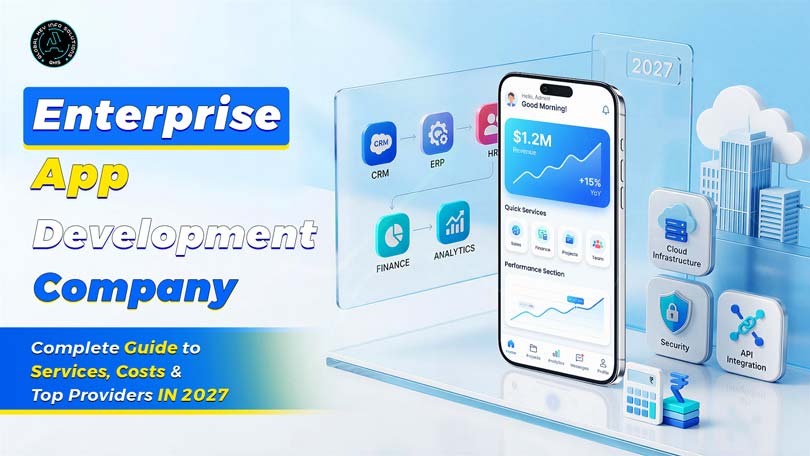
Every large organization eventually hits the same wall: the spreadsheets, disconnected tools, and off-the-shelf software that worked at 50 employees start breaking down at 500. That is where enterprise app development comes in. It is the discipline of building custom, secure, and highly scalable software that runs core business operations from supply chain and finance to HR, customer service, and field operations instead of forcing a business to bend around generic tools.
Read More: Top Android App Development Trends
The category has grown fast because digital-first operations are now a competitive necessity rather than a nice-to-have. Enterprises are replacing legacy ERP add-ons and manual workflows with purpose-built platforms that integrate cleanly with existing systems, scale to thousands of users, and meet strict security and compliance requirements. This guide breaks down what enterprise application development services actually include, what they cost, which technologies power them, how the leading providers compare, and how a company like GKIS approaches enterprise-grade delivery.
What Is Enterprise App Development?
Enterprise app development refers to designing, building, and maintaining custom software created specifically for the internal operations or customer-facing needs of a large organization. Unlike consumer apps, which are built for mass usage and simple interactions, enterprise applications are engineered around complex business logic, multiple user roles, high data volumes, and deep integration with systems such as ERP, CRM, HRMS, and legacy databases. Security, uptime, and long-term maintainability matter far more than flashy design, because these applications often become the backbone of daily operations for thousands of employees or customers.
Core Enterprise App Development Services
Providers in this space typically package their work into a handful of well-defined service lines. Understanding each one helps in scoping a project accurately and comparing vendor proposals apples-to-apples.
1. Custom Enterprise Application Development
This is ground-up development of software tailored to a specific workflow inventory management, procurement, logistics tracking, or a bespoke customer portal. The goal is a system that fits the business process exactly, rather than a generic tool the business has to adapt to.
2. Legacy System Modernization
Many enterprises still run critical operations on decade-old systems that are expensive to maintain and difficult to secure. Modernization work re-platforms these systems onto current architectures, migrates data safely, and preserves business continuity throughout the transition.
3. Enterprise Mobility Solutions
Enterprise mobile app development extends core business systems to smartphones and tablets so field teams, sales staff, and remote employees can access real-time data, submit updates, and collaborate without being tied to a desk. This is one of the fastest-growing segments within enterprise application development services.
4. Cloud-Native Enterprise Applications
Building directly on AWS, Microsoft Azure, or Google Cloud lets enterprise apps scale elastically, reduce infrastructure overhead, and roll out updates without downtime. Cloud-native architecture has become the default starting point for new enterprise builds rather than an optional add-on.
5. Enterprise System Integration
Enterprise software rarely operates in isolation. Integration work connects ERP, CRM, payment gateways, and third-party APIs so data flows automatically between systems, eliminating manual re-entry and the data silos that slow decision-making.
6. Support, Maintenance & Managed Services
Launch is the beginning, not the end. Ongoing services include performance monitoring, security patching, bug fixes, and iterative feature development to keep the application aligned with changing business needs.
Key Benefits of Enterprise Application Development
- Operational efficiency: Automating manual, repetitive workflows across departments cuts processing time and reduces human error.
- Stronger security and compliance: Purpose-built access controls, encryption, and audit trails are easier to enforce in custom software than in patched-together generic tools.
- Scalability: Cloud-native architecture supports growth from hundreds to millions of users without a rebuild.
- Better decision-making: Centralized, real-time data and analytics dashboards replace fragmented spreadsheets and delayed reporting.
- Competitive differentiation: A workflow or customer experience built around a company's specific processes is difficult for competitors using off-the-shelf software to replicate.
Explore More: Flutter vs Kotlin Multiplatform
Common Challenges in Enterprise App Development and How to Solve Them
Device and platform fragmentation. Enterprises run on a mix of operating systems, browsers, and device types. Using cross-platform frameworks such as Flutter or React Native, alongside responsive web architecture, keeps the experience consistent without maintaining separate native codebases for every platform.
Security and regulatory risk. Enterprise apps handle sensitive financial, health, or customer data, so compliance cannot be an afterthought. Encryption at rest and in transit, role-based access control, and independent security audits need to be built into the architecture from day one.
Legacy system integration. Connecting a new application to systems that are 10–15 years old requires careful middleware and API design so data keeps flowing without disrupting operations that the business depends on daily.
Performance at scale. Slow load times directly hurt adoption. Load balancing, caching, and cloud-based performance optimization keep the application responsive even during peak usage.
User adoption. A technically sound application that employees find confusing will still fail. Usability testing and iterative UX design based on real user feedback are what actually drive adoption.
Top Enterprise App Development Companies to Know in 2027
Enterprises evaluating a development partner typically weigh engineering depth, industry experience, integration capability, and long-term support. The market includes everyone from global IT majors to specialized digital engineering firms and India-based enterprise application development companies. The table below compares some of the most-referenced names in the space alongside GKIS.
|
Company |
Best Fit For |
Notable Strength |
|
GKIS (Global Key Info Solutions) |
Mid-market and growing enterprises needing custom apps, ERP/CRM integration, and AI-enabled features on a transparent, India-based delivery model |
Full-cycle delivery, DPDPA-aware development for the Indian market, dual onshore/offshore pricing |
|
Tata Consultancy Services (TCS) |
Global enterprises running large, multi-country application estates |
Massive delivery scale, deep ERP and legacy modernization experience |
|
Capgemini |
Enterprises modernizing around SAP, Salesforce, or Microsoft ecosystems |
Consulting-led transformation tied to business-process change |
|
Simform |
Cloud-native platforms and monolith modernization |
Co-engineering model with strong DevSecOps and integration focus |
|
EPAM Systems |
Custom, technically complex platforms delivered across markets |
Product-engineering discipline applied to enterprise software |
|
Infosys |
AI-powered digital transformation at enterprise scale |
Strong mainframe modernization and analytics capability |
|
HCLTech |
Large legacy application portfolios needing rationalization |
Broad platform coverage across SAP, Salesforce, and ServiceNow |
|
Appinventiv |
AI-first product engineering, including GenAI features |
Strong mobile and AI/ML product development track record |
|
TechAhead |
Enterprise mobility and AI-native application modernization |
ISO 42001-certified frameworks and enterprise mobility depth |
For enterprises comparing large global consultancies against specialized providers, GKIS positions itself in the latter category: a full-cycle enterprise application development company that pairs hands-on engineering with India-specific compliance knowledge, including the Digital Personal Data Protection Act (DPDPA), 2023, and UPI-based payment integrations for domestic enterprise platforms.
Enterprise App Development Cost in 2027
Pricing depends on the complexity of business logic, the number of integrations, security requirements, and whether the project is a new build or a modernization effort. The table below gives a directional range for planning purposes.
|
Application Tier |
Estimated Cost (USD) |
Estimated Cost (INR) |
|
MVP / core-feature enterprise app |
$25,000 – $60,000 |
₹21,00,000 – ₹50,00,000 |
|
Mid-scale app with integrations |
$60,000 – $150,000 |
₹50,00,000 – ₹1,25,00,000 |
|
Large / enterprise-grade platform |
$150,000 – $400,000+ |
₹1,25,00,000 – ₹3,30,00,000+ |
India-based delivery models, including the one GKIS uses, generally sit toward the lower end of these ranges for comparable scope, largely due to lower senior-engineering costs relative to US or Western European rates without necessarily compromising on architecture quality or security posture.
Technology Stack Commonly Used
- Frontend & mobile: React, Angular, Flutter, React Native, Kotlin, Swift
- Backend: Node.js, Java, .NET, Python (Django)
- Cloud & DevOps: AWS, Microsoft Azure, Google Cloud, Docker, Kubernetes, Terraform
- Data & integration: PostgreSQL, MongoDB, REST/GraphQL APIs, Kafka for event streaming
- Security: OAuth 2.0, role-based access control, encrypted data stores, SOC 2 / ISO 27001-aligned practices
How to Choose the Right Enterprise App Development Company
- Verify hands-on experience with enterprise-scale systems, not just consumer apps or landing pages
- Check integration capability with your existing ERP, CRM, or legacy databases
- Confirm security and compliance practices relevant to your industry and geography (GDPR, HIPAA, DPDPA, PCI DSS)
- Ask for named case studies with measurable outcomes, not generic claims
- Clarify the support and maintenance model after go-live this is where long-term value is either protected or lost
- Evaluate communication and delivery transparency across time zones if working with an offshore or India-based team
Why Enterprises Choose GKIS
GKIS is a Noida-based IT and digital transformation company founded in 2020, serving clients across the USA, UK, and UAE. The team has delivered 500+ projects across mobile app development, AI/ML, cloud infrastructure, ERP/CRM integration, UI/UX, and digital marketing, working with a team of 200+ professionals across 15+ countries. For enterprises evaluating a development partner, GKIS offers a full-cycle model from discovery and architecture through development, QA, deployment, and ongoing support with pricing structured in both USD and INR, and development practices aligned with India's DPDPA, 2023 for enterprises handling Indian user data.



0 Comments
Leave a comment