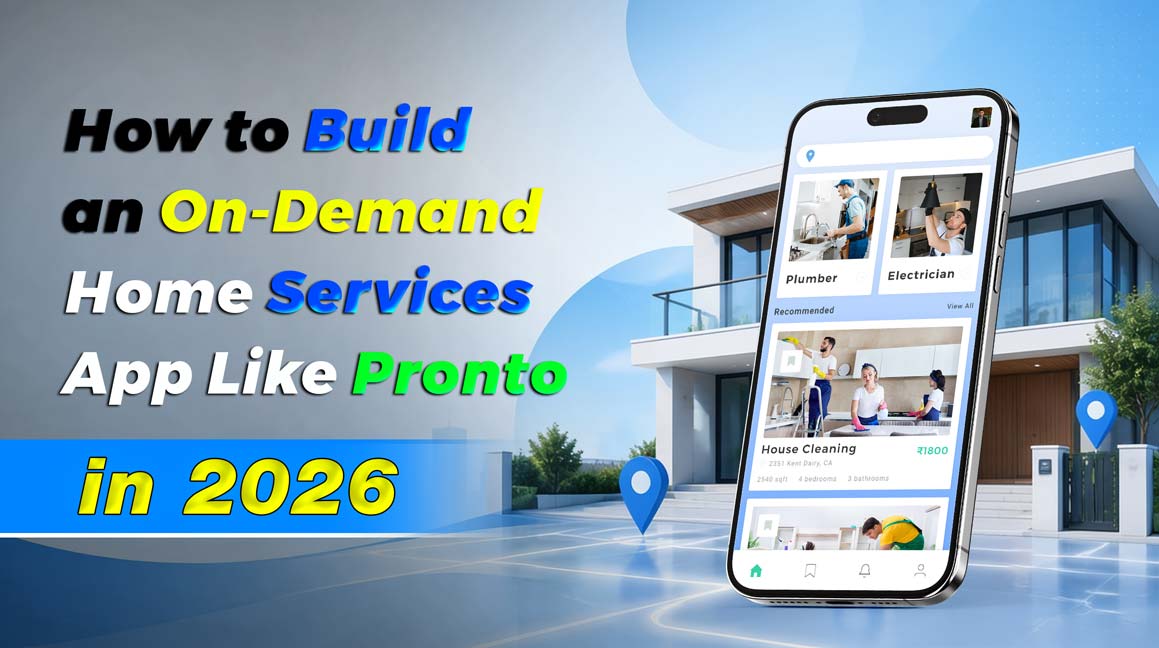
India's urban households have a problem that never quite goes away: finding reliable, on-time help for everyday chores. The housemaid who disappears without notice. The plumber who takes three calls to show up. The laundry service that charges differently every time.
Pronto, launched in 2024, decided to solve exactly this. Branded as "House Help in 10 Minutes," it built a hyperlocal, app-first platform connecting verified, trained workers with urban households and in just four months, it cleaned 50,000+ homes, crossed ₹8 crore in annualised revenue ($1M ARR), and trained 600+ women workers. It is now in talks to raise $25 million at a $100 million valuation.
Read More: How to Develop a Video Dating App
That trajectory tells you something important: the on-demand home services market in India is not a future opportunity it is a present one, and it is growing fast.
If you are a startup founder, product manager, or enterprise decision-maker thinking about building a home On-Demand app development services, this guide covers everything you need to know from market size and core features to tech stack, AI capabilities, development cost, and how to get started.
The Market Opportunity: Why Now Is the Right Time
India's online home services market is projected to grow at 18–22% annually and reach approximately ₹85,000–88,000 crore by FY30. The broader home services industry was valued at over ₹5.1 lakh crore in FY25, but the vast majority of it remains offline and unorganised which means digital platforms have enormous headroom.
Globally, the on-demand home services industry is expected to reach $1.57 trillion by 2030. In major cities like Bengaluru, Mumbai, Delhi NCR, and Hyderabad, app-based service bookings have grown by 40–45% year-on-year. Over 90% of bookings now happen on smartphones rather than through phone calls or walk-ins.
Explore More: How to Build an EV Charging Station Finder App
Several factors are driving this shift in India specifically:
Quick commerce habits. Apps like Zepto and Blinkit have trained urban consumers to expect instant delivery. That expectation has now extended to services, not just products.
Rise of working dual-income households. Urban professionals increasingly outsource household maintenance. Time is the constraint, not money.
Distrust of informal channels. Hiring help through WhatsApp networks or local brokers offers no accountability. Verified, rated service providers on a digital platform solve a real trust gap.
UPI and digital payments. India's payment infrastructure now makes cashless transactions frictionless even for small-ticket services like a cleaning session.
Tier-2 and tier-3 city expansion. Cities like Lucknow, Indore, Jaipur, and Nagpur are witnessing rapid smartphone adoption and rising demand for organised home services.
What Is the Pronto App and How Does It Work?
Pronto is an on-demand home services platform that operates on a hyperlocal, hub-and-spoke model. Here is how its core workflow functions:
- A user opens the app and selects the service they need — home cleaning, utensil washing, laundry, or more.
- The platform matches the user with a trained, background-verified worker available within their locality.
- The worker arrives within 10 minutes (for instant bookings) or at the scheduled time.
- Payment is handled in-app via UPI, cards, or wallets.
- Post-service, the user rates the worker and the experience.
What makes Pronto different from generic aggregators is its employment model. Workers are not random gig contractors they are hired in shifts, given fixed working hours, and assigned to specific hyperlocal zones. This gives them income stability and Pronto a reliable, consistent supply of available help.
The platform supports three booking modes: instant booking, scheduled booking (choose a date and time in advance), and recurring subscription services (weekly or monthly cleaning, for example).
Key Players in the On-Demand Home Services Space
Before building, it helps to understand who else is operating in this market and what they are each doing well.
|
App |
Country/Market |
Key Focus |
Differentiator |
|
Pronto |
India |
Home cleaning, laundry, household help |
10-minute arrival, shift-based workers |
|
Urban Company |
India, UAE, Australia |
Multi-category home services |
Premium positioning, trained professionals |
|
TaskRabbit |
USA, UK, Europe |
Handyman, moving, furniture assembly |
Freelancer marketplace model |
|
Tidy |
USA |
Recurring home cleaning |
Subscription-first, consistent cleaners |
|
Handy |
USA, UK, Canada |
Cleaning and handyman |
Flat-rate pricing transparency |
|
Helpling |
Germany, UK, Australia |
Home cleaning |
Background-verified cleaners |
|
Airtasker |
Australia, UK |
Multi-service tasks |
Community bidding model |
|
Merry Maids |
USA |
Professional cleaning |
Franchise-backed consistency |
In India, Urban Company remains the most established player, but Pronto's speed-first positioning and employment model are attracting significant investor attention in the ₹2,000–₹3,000 monthly household spend segment.
Types of Home Services Apps You Can Build
Not every on-demand Mobile app development services needs to look like Pronto. The category is broad:
On-demand cleaning apps — Instant or same-day bookings for home cleaning, bathroom cleaning, kitchen cleaning, deep cleaning. Pronto falls here.
Subscription-based cleaning apps — Users subscribe to weekly or monthly service plans. Predictable revenue for the platform; convenience for users.
Multi-service home apps — Combine cleaning, plumbing, electrical, carpentry, pest control, and AC servicing in one platform. Urban Company follows this model. Businesses looking to bring multiple services together can also explore a 𝐦𝐮𝐥𝐭𝐢-𝐬𝐞𝐫𝐯𝐢𝐜𝐞 𝐚𝐩𝐩 approach, allowing different offerings to operate through a single platform. This model can help organize service categories, bookings, payments, and user interactions within one digital experience.
Specialized service apps — Focus on a single niche: post-construction cleaning, move-in/move-out cleaning, car washing, or sofa cleaning.
Corporate cleaning apps — Target office buildings, retail chains, and commercial establishments for B2B cleaning contracts.
Platform aggregator apps — Let multiple independent service providers list themselves; users compare and book. Marketplace model with lower supply-side control.
Choosing the right model depends on your target city, user segment, and the supply side you are able to build. A focused MVP say, home cleaning in two or three localities of one metro is almost always the right starting point.
Core Features of an On-Demand Home Services App
A production-ready home services app like Pronto involves three separate interfaces, each with its own feature set.
User App
- Seamless onboarding with mobile number / Google / Apple sign-in
- Service catalogue with clear descriptions, images, and pricing
- Instant booking and scheduled booking with time-slot selection
- Recurring service subscription setup
- Real-time GPS tracking of the assigned worker
- In-app chat and call with the worker
- Secure payment via UPI, cards, net banking, and wallets
- Push notifications for booking confirmation, worker arrival, and reminders
- Ratings and reviews after service completion
- Service history and repeat booking with one tap
- Referral programme and loyalty rewards
- SOS / emergency cancel option
Service Provider (Worker) App
- Profile setup with skills, availability, and service zone
- Real-time booking notifications with accept/decline flow
- In-app navigation to customer location
- Digital checklist for each service type
- Earnings dashboard with daily/weekly payout tracking
- In-app chat with customers and support team
- Leave and availability management
Admin Dashboard
- Real-time order management and dispatch console
- Worker onboarding, training records, and background verification status
- Zone-wise demand and supply analytics
- Revenue and commission reports
- Customer support ticket management
- Promotions, discount codes, and campaign management
- Fraud detection and payment reconciliation
Advanced Features Powered by AI and Emerging Technology
In 2026, basic booking and matching is table stakes. What differentiates a competitive home services platform is how intelligently it operates. Here are the AI-powered capabilities worth building:
AI-Powered Worker Matching Instead of assigning the nearest available worker, machine learning models consider the worker's past rating for that specific service type, the customer's historical preferences, peak demand predictions by zone, and estimated travel time. The result is a better match and better reviews.
Predictive Demand Forecasting ML models trained on booking history, weather data, local events (Diwali, New Year, housing society move-ins), and day-of-week patterns can predict demand spikes 24–48 hours in advance. This allows the platform to proactively recruit additional workers in high-demand zones.
Dynamic Pricing Engine Like cab aggregators, home services apps can implement surge pricing during peak hours (Sunday mornings, pre-festival windows) while offering discounted rates during low-demand slots to balance supply and demand.
Conversational Booking via Chatbot An AI chatbot on WhatsApp or within the app allows users to book services through natural language: "Book a kitchen cleaning for tomorrow 9 AM" without navigating menus. This reduces drop-off in the booking funnel.
Computer Vision for Quality Inspection Workers can upload before-and-after photos of their completed work. An AI model can flag quality issues or verify that the checklist was completed creating a digital audit trail without requiring a human supervisor on-site.
Smart Subscription Recommendations Based on a user's booking frequency, the platform can suggest the most cost-effective subscription plan and switch them automatically with one tap.
IoT and Smart Home Integration Emerging platforms are beginning to integrate with smart home devices allowing users to unlock their door for a worker remotely, or trigger a robotic vacuum post-service. While nascent in India, this is a significant differentiator in premium urban segments.
Voice Command Booking Integration with Google Assistant or Alexa for hands-free booking: "Hey Google, book my weekly cleaning."
Recommended Tech Stack for 2026
|
Layer |
Technology |
|
Mobile Frontend |
Flutter (Android + iOS from single codebase) or React Native |
|
Web Admin Dashboard |
React.js + Tailwind CSS |
|
Backend / API |
Node.js with Express.js or NestJS |
|
Database |
PostgreSQL (relational data: users, bookings, payments) + MongoDB (logs, reviews, flexible schemas) |
|
Real-Time Features |
WebSockets via Socket.io (live worker tracking, chat) |
|
Maps & Geolocation |
Google Maps Platform (routing, distance matrix, place autocomplete) |
|
Push Notifications |
Firebase Cloud Messaging (FCM) |
|
Payment Gateway |
Razorpay or Cashfree (UPI, cards, wallets — India-optimised) |
|
Authentication |
Firebase Auth or Auth0 with OTP via Twilio / MSG91 |
|
Cloud Infrastructure |
AWS (EC2, RDS, S3) or Google Cloud Platform |
|
AI/ML Services |
Python (FastAPI or Flask) + TensorFlow / scikit-learn for matching and demand models |
|
Search & Recommendations |
Elasticsearch or Algolia |
|
Analytics |
Mixpanel (product analytics) + Metabase (business dashboards) |
|
CI/CD |
GitHub Actions + Docker + Kubernetes |
|
Background Verification API |
SpringVerify or IDfy (CKYC, Aadhaar, police verification) |
For India-specific compliance, the platform must adhere to the Digital Personal Data Protection Act (DPDPA) 2023, which governs how user data is collected, stored, and processed. Consent management, data minimisation, and grievance officer appointment are mandatory requirements.
Check It: AI in Mobile App Development Guide
Step-by-Step Development Process
Phase 1 — Discovery and Market Validation: Define your target city, service category, and user persona. Map the competitive landscape. Build financial models for unit economics (cost per booking, worker earning per shift, CAC, LTV). Validate with 20–30 potential users and 10–15 potential service providers through interviews before writing a single line of code.
Phase 2 — Product Design: Create information architecture and user flows for all three apps. Build high-fidelity Figma prototypes. Run usability testing sessions with real users. Design should prioritise speed a user should be able to complete a booking in under 60 seconds.
Phase 3 — MVP Development: Build the core booking flow, worker assignment, payment, and ratings. Launch with one service category (e.g., home cleaning) in one or two zones of one city. An MVP does not need AI matching or IoT it needs reliable booking and reliable workers.
Phase 4 — Quality Assurance: Functional testing across Android and iOS. Load testing (simulate 500 concurrent bookings). Payment gateway end-to-end testing. Security audit covering OWASP Top 10.
Phase 5 — Launch and Growth (Ongoing) Soft launch with a waitlist in a single locality. Collect feedback aggressively in the first 30 days. Iterate on pain points before scaling to new zones. Track weekly active users, repeat booking rate, and worker retention as your north star metrics.
Phase 6 — Feature Expansion Once unit economics are validated in one zone, add AI-powered features, new service categories, and subscription plans. Expand to new cities only after achieving profitability per zone.
Development Cost in India
Building in India offers a significant cost advantage compared to North America or Europe, without sacrificing quality provided you partner with the right development team.
|
App Variant |
Features |
Estimated Cost (INR) |
Timeline |
|
Basic MVP |
User app, worker app, admin panel, booking, payments, ratings |
₹15–25 lakh |
3–4 months |
|
Mid-Level App |
Above + GPS tracking, in-app chat, AI matching, subscription |
₹35–55 lakh |
5–7 months |
|
Full-Featured Platform |
Above + demand forecasting, dynamic pricing, IoT, multi-city |
₹70 lakh–₹1.2 crore |
8–12 months |
Ongoing costs to account for: cloud infrastructure (₹25,000–₹1.5 lakh/month depending on scale), payment gateway fees (1.5–2% per transaction on Razorpay), background verification per worker (₹200–₹500 per check), and a maintenance retainer for bug fixes and feature updates (typically 15–20% of the build cost annually).
Monetization Strategies
A home services platform has multiple revenue levers, and the best platforms combine several:
Commission per booking — The platform takes 15–25% of each transaction as a service fee. This is the primary revenue model for most on-demand apps, including Pronto.
Subscription plans — Users pay ₹499–₹1,499/month for priority booking, discounted rates, and guaranteed slot availability. This drives predictable MRR and significantly improves retention.
Worker registration and training fees — Charge workers a nominal one-time onboarding or certification fee (₹200–₹500) to fund training programmes.
Premium service tiers — Offer standard, premium, and deep-clean variants at different price points. Premium tier commands 30–40% higher margins.
In-app advertising — Partner with cleaning product brands, home fragrance companies, and appliance manufacturers for targeted in-app promotions.
B2B contracts — Corporate cleaning contracts for housing societies, co-working spaces, and offices provide high-volume, recurring revenue with lower CAC than consumer bookings.
Referral programmes — Incentivise users to bring in friends with credits. Acquisition cost via referral is typically 5–8x lower than paid advertising.
Key Challenges and How to Address Them
Supply-side reliability. The biggest risk in any home services app is worker no-shows. Pronto solved this by employing workers in shifts (not on a gig basis), ensuring consistent supply. Building a strong worker community with stable earnings, on-time payouts, and non-monetary benefits (insurance, upskilling) dramatically reduces churn.
Trust and safety. Users are allowing a stranger into their home. Background verification (Aadhaar + police verification), visible worker profiles with photos and rating histories, and an in-app emergency contact feature are non-negotiable trust signals.
Hyperlocal supply-demand balance. Demand spikes on Sunday mornings and festival eves; supply can be thin. Predictive scheduling tools, incentive-based availability nudges to workers, and advance booking options help smooth these peaks.
Worker classification and compliance. India's evolving gig economy regulations including the Code on Social Security 2020 require platforms to provide minimum benefits to gig workers. Building compliance into your HR and payroll stack from Day 1 is far easier than retrofitting it later.
Unit economics at scale. Many on-demand platforms achieve GMV growth but struggle to achieve per-booking profitability. Model your economics early: average order value (AOV), worker earning per shift, platform commission, and CAC must all be stress-tested before fundraising.
Why GKIS for Your Home Services App Development
At Global Key Info Solutions (GKIS), we have helped founders and enterprises across 5+ countries build on-demand platforms that balance speed, reliability, and scalability. Our 50+ professionals bring deep expertise in Flutter, React Native, Node.js, AI/ML, and cloud infrastructure everything required to ship a production-ready home services app.
We do not just write code. We work with you to validate your product-market fit, define the right MVP scope, design intuitive user experiences, and build backend systems that scale from 100 bookings a day to 100,000. We understand the India-specific requirements: Razorpay/Cashfree integration, DPDPA 2023 compliance, Aadhaar-based background verification, and UPI-first payment flows.
Whether you want to build a Pronto-style instant cleaning app, an Urban Company-style multi-service platform, or a niche B2B corporate services product — we have the capabilities to take you from idea to launch.
Talk to our team today to get a detailed proposal and project roadmap for your home services app.




0 Comments
Leave a comment