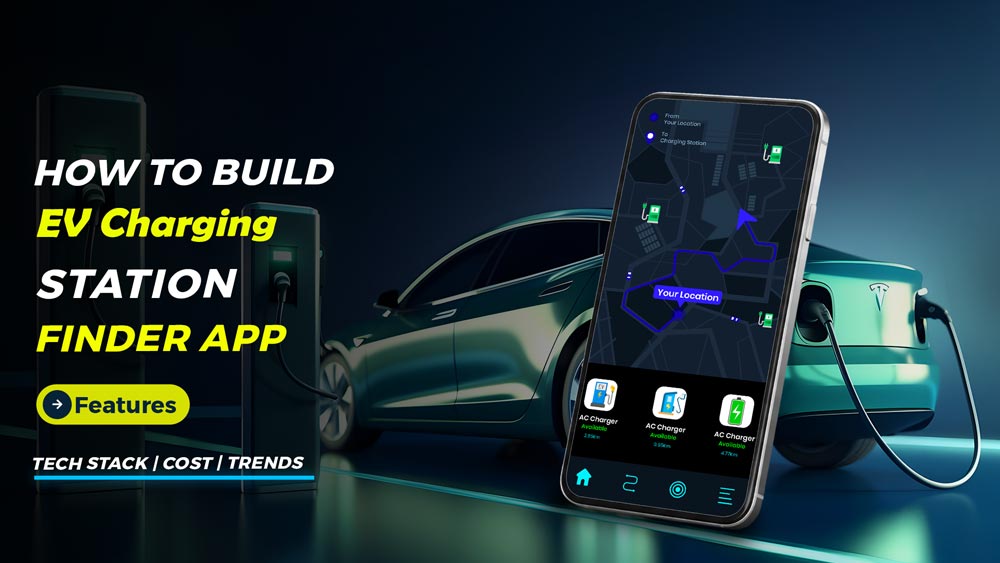
The electric vehicle revolution is no longer a distant future it is happening right now, and at extraordinary speed. Global EV sales crossed 17 million units in 2024, and by 2030, analysts expect more than 40% of all new vehicles sold worldwide to be electric. As roads fill up with EVs, one critical challenge dominates every driver's day: finding a reliable, available, compatible charging station.
Build Your EV Charging App Today
EV app idea into a fully functional, revenue-ready product with GKIS
Get a Free Consultation →This is exactly where the opportunity lies. The EV charging app market valued at approximately $28.47 billion in 2025 is projected to reach $76.31 billion by 2032, growing at a CAGR of 15.1%. Businesses, energy companies, CPOs (Charge Point Operators), and startups are all racing to build the next-generation EV charging station finder app that solves real-world pain points for millions of drivers.
If you are evaluating whether to build one, this guide covers everything from features and tech stack to development steps, cost estimates, and the latest trends determining the space in 2026.
Why EV Charging Apps Matter More Than Ever
One of the biggest challenges EV drivers face is range anxiety the fear of running out of battery before reaching a charging station. While charging infrastructure continues to expand globally, finding available, compatible, and reliable charging points remains a major concern.
Modern EV charging station finder apps solve this problem by providing real-time charger availability, route optimization, payment integration, and booking capabilities. For businesses, these applications create new revenue opportunities while helping accelerate EV adoption.
Read More: Mobile App Development for Startups
At GKIS, we have analyzed leading EV charging platforms and identified that user experience, real-time data accuracy, and seamless payment processing are the three factors that most influence app adoption and retention.
-
Understanding the EV Charging Ecosystem
Before writing a single line of code, it helps to understand the infrastructure your app will operate within.
EV charging exists across three levels. Level 1 chargers use standard household outlets and deliver the slowest charge suitable for overnight home charging. Level 2 chargers, the most common type at public stations and workplaces, provide a meaningful charge in 4–8 hours. DC Fast Chargers (DCFC), also known as Level 3, deliver rapid charging in 20–60 minutes and are the primary target for highway and commercial networks.
These stations communicate with software systems using the Open Charge Point Protocol (OCPP) an open standard that allows charge point hardware from different manufacturers to talk to a common backend. Any serious EV charging app needs to be built with OCPP compatibility in mind, as it determines interoperability across hundreds of charging networks globally.
The key stakeholders your app must serve are EV owners (who need to find, book, and pay for charging), CPOs (who need to manage station availability, pricing, and revenue), and businesses or fleet operators (who need centralized control over charging infrastructure).
-
Market Opportunity and Why 2026 Is the Right Time to Build
The numbers tell a compelling story. India's EV market alone was valued at $5 billion and is growing at a CAGR of 44%, expected to exceed $47 billion by 2026. In the US, 18.7 million EVs are expected on roads by 2030, demanding a public charging network that is $39 billion deep in required investment. Europe's charging mandate under the Alternative Fuels Infrastructure Regulation (AFIR) is pushing aggressive station deployment across member states.
This infrastructure growth creates a direct demand for apps that make the charging experience effortless. The competition in the app space is still maturing which means the window to build a differentiated, well-engineered product and capture significant market share is wide open right now.
-
Must-Have Features of an EV Charging Station Finder App
A successful EV charging app is built across three panels User, Station Owner/CPO, and Admin. Each panel serves a distinct role in making the ecosystem work.
User Panel Features
Real-Time Charging Station Locator is the core of any EV app. Using GPS and live API data, users should be able to see nearby stations on an interactive map, with real-time status available, occupied, or offline. Accuracy here is non-negotiable; stale data destroys trust faster than any other failure.
Smart Search and Advanced Filters allow users to sort and filter stations by charger type (AC/DC), connector standard (CCS, CHAdeMO, Type 2), charging speed, pricing, distance, and amenities. This saves time and reduces range anxiety two of the biggest friction points for EV drivers.
Route Planning and Navigation Integration takes the app beyond a simple directory. By integrating with Google Maps or Apple Maps, users can plan multi-stop journeys with charging waypoints automatically suggested based on their vehicle's estimated range.
Slot Booking and Reservation lets users reserve a charger in advance, eliminating the frustration of arriving at a station only to find it fully occupied. This feature alone significantly improves user retention.
In-App Payment Gateway must support cards, digital wallets, UPI, and subscription or membership plans. PCI-DSS compliance is mandatory. A seamless, one-tap payment experience is what separates a good app from a great one.
Charging Session Tracker allows users to monitor their session in real time viewing energy delivered, time elapsed, cost accrued, and estimated completion all from the app while they step away for a coffee.
Explore More: SaaS vs. Custom Software Development
Other important user-side features include push notifications for slot availability and session completion, ratings and reviews for stations, a detailed charging history with digital receipts, and a loyalty rewards program that incentivizes repeat usage.
CPO / Station Owner Panel Features
Charge Point Operators need a robust management dashboard where they can monitor all their stations in real time, update availability status, configure dynamic pricing, access revenue reports, and manage user feedback. Remote diagnostic and restart capabilities reduce on-ground maintenance costs significantly.
Admin Panel Features
The admin panel is the control room of the entire ecosystem. It handles centralized user and station management, transaction oversight, commission configuration, push notification management, analytics dashboards, and API access control. A well-designed admin panel is what makes an EV charging platform scalable from 50 stations to 50,000.
-
Advanced and AI-Powered Features for 2026
Standard features get your app to market. Advanced features build your competitive trench.
Predictive Charger Availability uses machine learning to analyze historical usage patterns and predict which stations will be available at a given time on a given day. This is one of the highest-value features for reducing range anxiety and improving route planning confidence.
Dynamic Pricing Engine adjusts charging rates based on demand, grid load, time of day, and station operator settings similar to surge pricing in ride-hailing apps. It optimizes revenue for CPOs while giving price-conscious users the ability to charge during off-peak windows.
EV Range Estimator and Battery Integration connects with the vehicle's telematics via OBD-II or OEM APIs (Tesla, Tata EV, etc.) to display real-time battery status inside the app and automatically adjust recommendations based on current charge level.
Carbon Footprint Tracker is increasingly important for sustainability-conscious users and corporate fleets. It calculates and displays the CO₂ saved per charging session versus petrol, adding emotional and ESG value to the app experience.
Fleet Management Module caters to commercial operators managing tens or hundreds of EVs. It includes centralized billing, driver assignment, route optimization, and consolidated reporting a separate revenue stream for your platform.
Voice Assistant Integration (Google Assistant, Siri, Alexa) lets drivers find nearby chargers and initiate navigation hands-free while driving a safety feature that also improves user engagement.
-
UI/UX Design Principles for EV Charging Apps
EV charging apps are used while driving, in parking lots, and under time pressure. The UI/UX must be designed for one-thumb navigation, glanceability, and speed. A map-first interface should dominate the home screen, with search and filters accessible within one tap.
The primary UX design flow should be frictionless: Find → Filter → Book → Navigate → Charge → Pay → Review. Every additional step in that flow costs you users. Reduce cognitive load by pre-filling user preferences (favourite connector type, vehicle model) and storing payment details securely for one-tap checkout.
Dark mode support, high-contrast map markers (color-coded by availability), accessibility compliance (WCAG 2.1), and multilingual support are baseline requirements for any app targeting global users in 2026.
-
Tech Stack for EV Charging Station Finder App Development
Choosing the right technology stack is a foundational decision that determines your app's performance, scalability, and long-term maintenance cost.
|
Layer |
Recommended Technologies |
|
Mobile Frontend |
React Native (cross-platform), Flutter, Swift (iOS), Kotlin (Android) |
|
Web / Admin Panel |
React.js, Next.js, Angular |
|
Backend |
Node.js, Python (FastAPI / Django), Laravel |
|
Database |
PostgreSQL, MongoDB, Firebase Realtime DB |
|
Real-Time Communication |
WebSockets, Socket.io, MQTT (for IoT/OCPP) |
|
Maps & Geolocation |
Google Maps API, Mapbox, HERE Maps |
|
Payment Integration |
Stripe, Razorpay, Braintree, PayPal |
|
EV Data APIs |
Open Charge Map API, PlugShare API, ChargePoint API, OCPP |
|
IoT / Device Communication |
AWS IoT Core, MQTT over WSS |
|
Cloud Infrastructure |
AWS, Google Cloud Platform, Microsoft Azure |
|
Push Notifications |
Firebase Cloud Messaging (FCM), OneSignal |
|
Analytics |
Firebase Analytics, Mixpanel, Google Analytics |
|
DevOps |
Docker, Kubernetes, CI/CD pipelines |
For real-time charger status updates, MQTT over WebSockets is the protocol of choice it is lightweight, low-latency, and perfectly suited for IoT-heavy environments like charging station networks. AWS IoT Core provides the managed infrastructure to handle millions of device signals (power, temperature, energy, session state) at scale.
-
Step-by-Step EV Charging App Development Process
Step 1: Discovery and Requirement Analysis
Define the app's purpose, target users, and feature scope. Conduct competitive analysis to identify gaps in existing apps and position your product distinctly. Define your MVP feature set what absolutely must be in version one.
Step 2: Market Research and Data Collection
Aggregate charging station data from public APIs (Open Charge Map, PlugShare, ChargePoint). Research legal and regulatory requirements in your target markets GDPR in Europe, data localization norms in India, PCI-DSS for payments globally.
Step 3: UI/UX Wireframing and Prototyping
Map out all user flows, create wireframes for every screen, and build an interactive prototype. Conduct usability testing with real EV drivers before development begins. This step saves enormous rework cost later.
Step 4: Platform and Architecture Decision
Choose between native (Swift/Kotlin) for maximum performance or cross-platform (React Native/Flutter) for faster development and lower cost. Design your backend architecture microservices are recommended for platforms expecting rapid scale.
Step 5: Backend and Database Development
Build REST or GraphQL APIs, design the database schema for users, stations, sessions, payments, and reviews. Implement OCPP integration for live charger communication. Set up authentication (OAuth 2.0, JWT) and role-based access control.
Step 6: Frontend and Mobile Development
Develop the mobile app, admin panel, and CPO dashboard in parallel. Integrate all third-party APIs maps, payments, EV data feeds, and push notifications.
Step 7: QA Testing and Security Audit
Conduct functional, performance, and security testing across all target devices and OS versions. Run penetration testing on payment flows and API endpoints. Validate OCPP communication under load conditions.
Step 8: Deployment and Launch
Submit to the App Store and Google Play. Set up cloud infrastructure with auto-scaling policies. Configure monitoring and alerting (Datadog, New Relic, or CloudWatch).
Step 9: Post-Launch Maintenance and Iteration
Monitor app performance and crash reports. Collect user feedback through in-app mechanisms. Prioritize feature updates based on usage data. A live EV app requires continuous improvement the charging landscape evolves rapidly.
-
EV Charging App Development Cost Breakdown
Development cost varies significantly based on complexity, platform choice, and team location. Here is a realistic breakdown for 2026:
|
Component |
Estimated Cost (USD) |
|
UI/UX Design |
$3,000 – $8,000 |
|
Mobile App Development (iOS + Android) |
$15,000 – $35,000 |
|
Backend Development |
$12,000 – $30,000 |
|
Admin + CPO Dashboard |
$6,000 – $15,000 |
|
API Integrations (Maps, EV Data, Payments) |
$4,000 – $10,000 |
|
QA & Security Testing |
$4,000 – $10,000 |
|
Cloud Setup & Deployment |
$1,500 – $4,000 |
|
MVP Total |
$25,000 – $60,000 |
|
Full-Featured Platform |
$60,000 – $150,000+ |
A basic V1 with core scenarios map, availability, payments, and session management typically falls in the $50,000–$70,000 range. White-label architecture, multi-market support, fleet modules, and AI features push costs higher but deliver proportionally stronger returns.
Key cost factors include feature complexity, the number of third-party integrations, whether you choose native or cross-platform development, and post-launch support scope.
-
Monetization Models for EV Charging Apps
Building a great app is one side of the equation generating sustainable revenue is the other. Here are the most effective monetization models for EV charging platforms:
Commission Per Charging Session is the most direct model. Charge a percentage fee on every transaction processed through the app between EV drivers and CPOs.
Subscription Plans (monthly/annual) offer EV drivers premium features like advance booking, exclusive station access, priority support, and discounted rates. Freemium conversion rates in the EV app space are strong drivers are highly motivated to reduce charging friction.
White Labeling allows CPOs, energy companies, and fleet operators to license your platform under their own brand. This creates a B2B revenue stream that scales independently of consumer app growth.
Data Monetization involves aggregating anonymized usage data charging patterns, peak demand by location, session durations and licensing it to urban planners, energy providers, and EV manufacturers. This is a high-margin, low-effort revenue stream at scale.
Fleet Management SaaS Plans serve commercial EV fleet operators with centralized billing, analytics, and driver management, typically priced on a per-vehicle monthly subscription basis.
-
Challenges and How to Overcome Them
Real-Time Data Accuracy is the biggest operational challenge. Charging station status changes in seconds a station marked available that is actually occupied causes immediate user frustration. Solving this requires direct OCPP integration with hardware, not reliance on manual station owner updates.
Fragmented Charging Standards mean your app must support CCS, CHAdeMO, Type 2, GB/T, and other connector types simultaneously, with clear filter logic for each market.
Payment Security requires PCI-DSS compliance, tokenized card storage, and robust fraud detection non-negotiable when handling thousands of micro-transactions daily.
User Retention beyond the first few sessions requires personalization saved vehicles, preferred station types, route history and proactive notifications that genuinely reduce friction rather than spam.
Leading EV Charging Apps in the Market
Before building your own platform, it's important to understand what existing market leaders offer.
|
App |
Key Strength |
Limitation |
|
PlugShare |
Large charging station database |
Limited booking features |
|
ChargePoint |
Strong network integration |
Availability varies by region |
|
Electrify America |
Fast charging support |
Focused primarily on North America |
|
Tesla App |
Deep vehicle integration |
Limited to Tesla ecosystem |
|
Custom EV App by GKIS |
Fully customizable, white-label, scalable |
Requires development investment |
Analyzing these platforms helps identify feature gaps and opportunities for innovation in your own EV charging application.
-
Future Trends in EV Charging App Development 2026
The EV charging app landscape is evolving faster than almost any other mobile category. These trends will define the next generation of platforms:
Vehicle-to-Grid (V2G) Integration enables bidirectional energy flow EVs discharge power back to the grid during peak On demand Apps development that support V2G session management will be at the forefront of the smart energy ecosystem.
AI-Driven Predictive Availability is becoming a baseline expectation rather than a premium feature. Apps that show not just current availability but predicted availability 30 minutes from now will win driver loyalty.
Blockchain-Based Energy Trading allows EV owners to sell surplus solar-generated energy directly to other users, creating peer-to-peer energy markets facilitated through the app.
5G-Powered Real-Time Monitoring enables sub-second status updates across thousands of stations simultaneously eliminating the latency that currently makes real-time data inaccurate in high-density urban environments.
Augmented Reality (AR) Navigation overlays charging station markers directly on the camera view as users approach an area reducing the "last 100 meters" navigation problem that plagues drivers in large parking structures.
Solar and Renewable Energy Tracking lets users preferentially select stations powered by renewable sources, enabling carbon-conscious charging decisions that increasingly matter to both individual consumers and corporate sustainability programs.
Why Build Your EV Charging App with GKIS?
At Global Key Info Solutions (GKIS), we bring deep mobile app development expertise to one of the fastest-growing sectors in the digital economy. Our team has delivered scalable, production-grade mobile applications across Android and iOS, with strong capabilities in real-time data systems, payment integrations, IoT connectivity, and AI-powered features.
When you build your EV charging station finder app with GKIS, you get end-to-end ownership from discovery and UI/UX design through backend architecture, API integration, QA, deployment, and post-launch support. We work with modern tech stacks (React Native, Node.js, Flutter, AWS) and follow agile development practices that keep your project on time and within budget.
Whether you are a startup launching an MVP, a CPO looking to build a white-label platform, or an enterprise integrating fleet management GKIS has the technical depth and domain understanding to deliver.
Talk to our team today and let's scope out your EV charging app together.
Want AI, Real-Time Data & Smart Booking in One App?
GKIS builds feature-rich EV charging apps with cutting-edge tech that users actually love
Explore Our Capabilities →




0 Comments
Leave a comment