In modern business operations, traditional rule-based automation is hitting a hard ceiling. While legacy tools excel at handling highly structured data, they break down the moment they encounter a messy customer email, an unformatted vendor invoice, or an ambiguous support ticket.
To bridge this gap, enterprises are rapidly turning to Generative AI workflow integration.
By embedding Large Language Models (LLMs) directly into business applications, companies can finally automate context-heavy, unstructured processes. However, with hundreds of AI vendors, model APIs, and low-code platforms flooding the market, choosing the right tool is highly complex. Selecting the wrong stack can lead to massive token costs, security vulnerabilities, or poor accuracy.
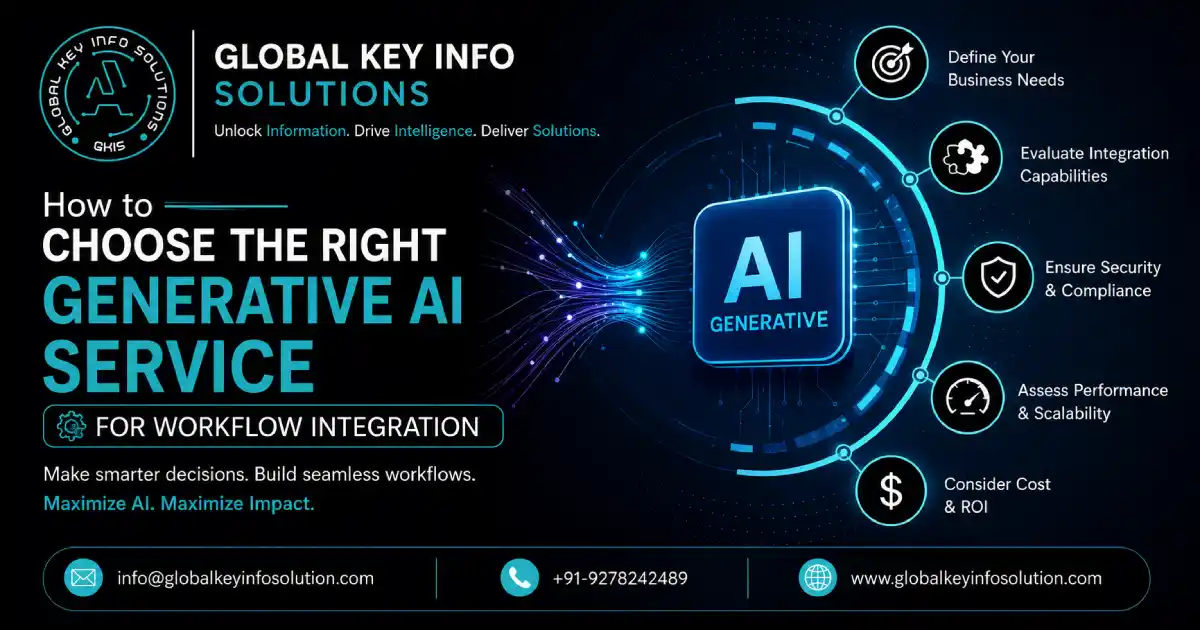
Here is a strategic, step-by-step framework to help your business select the perfect Generative AI service for seamless workflow integration.
1. Map Your Automation Taxonomy
Before evaluating vendors, you must diagnose the exact nature of the problem you are solving. Not every automation task requires a heavy-duty generative AI model. Using a million-parameter LLM to move clean data between two databases is an expensive overkill.
Consider where your problem falls in the automation landscape:
| Category | Primary Superpower | Ideal Use Case |
| Traditional iPaaS | Connects cloud applications and synchronises structured data. | Syncing CRM contacts directly to an accounting platform. |
| Legacy RPA | Mimics human clicks and keystrokes on desktop software interfaces. | Scraping data from an old desktop legacy system without web APIs. |
| AI Workflow Automation | Uses AI models to process unstructured data and make context-aware inferences. | Classifying customer support ticket sentiment, summarising leads, or auditing invoices. |
| Autonomous Agents | Code-driven frameworks that allow AI to plan its own multi-step execution. | Open-ended market research, complex data analysis, or adaptive coding pipelines. |
2. Evaluate the 5 Core Enterprise Pillars
When vetting a Generative AI service provider, look past marketing promises and focus on these five structural requirements:
A. Data Security and Privacy (The Non-Negotiable)
For enterprise integration, your data boundaries must be absolute. Ensure the service provider explicitly guarantees that your corporate data will not be used to train public models. Look for enterprise-grade compliance features such as SOC 2 Type II certification, robust encryption (both at rest and in transit), and strict Role-Based Access Control (RBAC).
B. Total Cost of Ownership (TCO)
The cost of Generative AI isn't just a fixed software subscription. A realistic budget must account for:
Model Token Fees: The ongoing cost per input and output character (tokens).
Infrastructure Costs: Hosting vector databases or orchestrator nodes.
API Execution Calls: High-frequency workflows can incur substantial hidden billing loops if left unoptimized.
C. Ease of Integration and Architecture
An AI service shouldn't require you to rip and replace your existing infrastructure. The ideal platform must offer clean API documentation, native SDKs for your development stack, and seamless support for Retrieval-Augmented Generation (RAG)—allowing the AI to securely access your internal knowledge bases without needing a costly model retraining process.
D. Model Flexibility and Future-Proofing
The AI ecosystem moves incredibly fast. A model that leads the market today might be outpaced next quarter. Choose a workflow platform that is model-agnostic, allowing you to swap out the underlying LLM (e.g., switching from OpenAI to Anthropic or an open-source Llama model) via simple configuration changes without rewriting your entire application logic.
E. Latency vs. Accuracy Balances
Determine if your workflow requires real-time execution or background batch processing. Customer-facing chatbots require ultra-low latency, meaning you might favour smaller, faster, and more cost-effective models. Conversely, complex legal document analysis or financial compliance auditing prioritises maximum accuracy over speed, justifying a larger, deeper reasoning engine.
3. Implementation: The Step-by-Step Rollout Blueprint
Once a platform is selected, success depends entirely on a structured rollout. Deploying an unvalidated model directly into a live production system introduces severe hallucination risks.
Conclusion: Partnering for Intelligent Automation
Choosing a Generative AI service isn't just a software purchase—it is a foundational business decision that shapes how your company scales its operations, secures its intellectual property, and handles customer data. By prioritising security, architectural flexibility, and a human-in-the-loop implementation strategy, you can turn AI from an experimental tool into a measurable engine of operational efficiency.
Ready for Intelligent AI Workflows?
Let Global Key Info Solutions design a secure, custom automation blueprint tailored exactly to your tech stack.
Get a Free Consultation →
6a60a6e873bfc.png)




0 Comments
Leave a comment