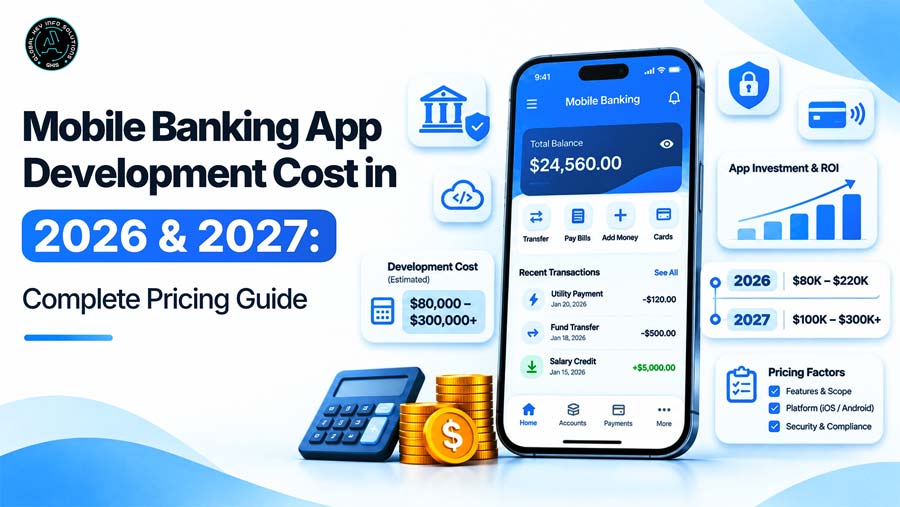
Mobile banking has moved from a convenience to the main way customers deal with their money. Digital banking app downloads rose sharply through 2025, and a 2026 industry benchmark report found that 82% of US mobile banking users are active in their bank’s app. For banks, credit unions, neobanks and fintech start-ups, the question is no longer whether to build, but what the mobile banking app development cost will be and where the budget actually goes.
Read More: Top 20 Healthcare App Development Companies
The honest answer is that it depends. A lean MVP built on a banking-as-a-service (BaaS) partner costs a fraction of a full digital bank with its own ledger, cards and lending. This guide breaks down banking app development cost in 2026 and 2027 by complexity, app type, feature, platform, region and development phase. It also covers compliance and licensing, hidden and ongoing costs, the latest trends moving budgets, and practical ways to save without weakening security. Prices are shown in USD with approximate INR equivalents at about ₹96 per US dollar, so Indian and global teams can plan from the same numbers.
Quick Answer: How Much Does It Cost to Develop a Mobile Banking App?
Most projects fall between $40,000 and $500,000+ (about ₹38 lakh to ₹4.8 crore+). A basic app with registration, balances, history and transfers typically costs $30,000–$80,000 and takes 3–5 months. A mid-level app with cards, bill payments, biometrics and analytics costs $80,000–$180,000 over 6–9 months. An enterprise digital banking platform with AI, fraud engines, Open Banking APIs and core banking integration costs $180,000–$500,000+ and takes 10–18 months. Teams that build in India usually pay noticeably less than teams in North America or Western Europe for the same scope.
Why the Cost of a Banking App Varies So Much
Two banking apps can look identical on a phone and still differ in price by ten times. The screens are the smallest part of the work. The real cost sits behind them: the backend and ledger logic, security architecture, regulatory compliance, third-party integrations and the ability to scale on salary day without failing.
Banking is also unforgiving. People forgive a plain interface, but they do not forgive a failed payment or a delayed alert. That is why testing, security validation and compliance take a larger share of a mobile banking app development budget than they do in most other app categories.
Mobile Banking App Development Cost by Complexity
|
App level |
Typical scope |
Cost (USD) |
Cost (INR, approx.) |
Timeline |
|
Basic banking app / MVP |
Registration, KYC, account overview, transaction history, basic transfers |
$30,000 – $80,000 |
₹29 lakh – ₹77 lakh |
3–5 months |
|
Mid-level banking app |
Cards, bill payments, QR payments, biometric login, notifications, spending analytics |
$80,000 – $180,000 |
₹77 lakh – ₹1.7 crore |
6–9 months |
|
Enterprise banking platform |
AI insights, fraud detection, lending or investing, Open Banking APIs, core banking integration |
$180,000 – $500,000+ |
₹1.7 crore – ₹4.8 crore+ |
10–18 months |
These ranges describe the app and its supporting backend. Licences, legal work and marketing are separate. Vendor quotes also vary, which is why one provider’s “basic” can be another’s “mid-level”. Always compare scope line by line rather than totals.
Cost by Type of Banking App
The financial product you build sets the architecture, the compliance load and the integrations you need. A consumer wallet is far simpler than a corporate banking platform.
|
App type |
Cost (USD) |
Main cost drivers |
|
Digital wallet and P2P payments |
$50,000 – $120,000 |
Tokenised vaults, low-latency gateways, QR and NFC payments |
|
Retail banking app |
$60,000 – $150,000 |
High transaction volumes, core ledger sync, bill pay rails |
|
Neobank / digital-only bank |
$120,000 – $350,000+ |
Cloud-native microservices, remote KYC, virtual card issuing, BaaS routing |
|
Wealth and investment app |
$130,000 – $320,000+ |
Real-time market data, trade execution, portfolio tracking |
|
Corporate banking app |
$150,000 – $400,000+ |
Role hierarchies, batch payments, payroll, treasury, approval workflows |
For neobank app development cost in particular, the build route matters more than the feature list. A BaaS-powered app commonly lands at $80,000–$180,000 in 6–12 months, licensing a white-label core banking system runs $200,000–$600,000 over 12–24 months, and building under your own bank charter can exceed $500,000 and take 18–36 months.
Mobile Banking App Features and Their Cost
Feature-level planning is the easiest way to decide what goes into version one. The figures below are indicative and assume a mid-market development team.
|
Feature |
Cost (USD) |
Cost (INR, approx.) |
|
User registration and login |
$2,000 – $5,000 |
₹1.9 – ₹4.8 lakh |
|
KYC and identity verification |
$5,000 – $10,000 |
₹4.8 – ₹9.6 lakh |
|
Account dashboard |
$3,000 – $8,000 |
₹2.9 – ₹7.7 lakh |
|
Fund transfers |
$5,000 – $15,000 |
₹4.8 – ₹14.4 lakh |
|
Card management (freeze, limits) |
$4,000 – $10,000 |
₹3.8 – ₹9.6 lakh |
|
Bill payments |
$5,000 – $12,000 |
₹4.8 – ₹11.5 lakh |
|
QR code payments |
$7,000 – $10,000 |
₹6.7 – ₹9.6 lakh |
|
Push notifications and alerts |
$2,000 – $5,000 |
₹1.9 – ₹4.8 lakh |
|
AI chatbot support |
$10,000 – $30,000 |
₹9.6 – ₹28.8 lakh |
|
Fraud detection engine |
$15,000 – $50,000 |
₹14.4 – ₹48 lakh |
Some features look simple but are not. A dashboard pulls balances, history and alerts from several systems. A transfer screen hides fraud controls, payment routing, reconciliation and audit logs. Fraud detection is often the most underestimated line, because the engine must analyse transactions continuously without blocking genuine customers. An admin panel for compliance, user management and monitoring is also easy to forget and can run to several hundred development hours.
Beyond the core set, mobile banking app features that raise both cost and competitiveness include savings goals, round-ups, spending analytics, bill splitting, wearable access, in-app investing and open banking account aggregation.
Cost Breakdown by Development Phase
|
Phase |
Cost (USD) |
Cost (INR, approx.) |
Share of budget |
|
Discovery and planning |
$8,000 – $15,000 |
₹7.7 – ₹14.4 lakh |
~10% |
|
UI/UX design |
$10,000 – $20,000 |
₹9.6 – ₹19.2 lakh |
~12% |
|
Frontend and backend development |
$35,000 – $85,000+ |
₹33.6 – ₹81.6 lakh |
~40% |
|
APIs and core banking integration |
$15,000 – $40,000 |
₹14.4 – ₹38.4 lakh |
~18% |
|
Testing and security validation |
$10,000 – $25,000 |
₹9.6 – ₹24 lakh |
~12% |
|
Deployment and launch |
$3,000 – $7,000 |
₹2.9 – ₹6.7 lakh |
~3% |
|
First-month support |
$4,000 – $8,000 |
₹3.8 – ₹7.7 lakh |
~5% |
Key Factors That Affect Banking App Development Cost
1. Feature scope and complexity
Every feature adds design, development and testing time. Core functions such as balances and transfers are quick; mobile check deposit, multi-currency accounts, lending and in-app investing take far longer. If the budget must come down, reduce scope before reducing security.
2. Security architecture
Banking apps are high-value targets, so security cannot be a late add-on. Biometric login, multi-factor authentication, end-to-end encryption, device binding, session management, tokenisation and real-time monitoring all need specialist engineering and independent testing.
3. Compliance and regulation
PCI DSS, KYC, AML, GDPR, PSD2 and local banking rules shape architecture, documentation and testing. Retrofitting compliance later is far more expensive than designing for it from day one.
4. Third-party and core banking integrations
Payment gateways, core banking systems, identity verification vendors, credit bureaus and notification services each add build and test effort. Core banking integration often sets the project schedule. Integrations and data migration can add roughly 20–30% to an initial build.
5. Technology stack and platform
Native development with Swift and Kotlin gives the best control over device security and performance but needs two codebases. Cross-platform frameworks such as Flutter and React Native share one codebase and reduce cost, which is why many teams use them for a first release.
|
Approach |
Cost (USD) |
Cost (INR, approx.) |
|
Android only |
$45,000 – $90,000 |
₹43 – ₹86 lakh |
|
iOS only |
$40,000 – $85,000 |
₹38 – ₹82 lakh |
|
Cross-platform (Flutter / React Native) |
$55,000 – $110,000 |
₹53 lakh – ₹1.06 crore |
|
Two native apps |
$80,000 – $170,000 |
₹77 lakh – ₹1.63 crore |
6. UI/UX design
User research, wireframes, prototypes, accessibility and usability testing take real time, but a clear interface lifts adoption and retention. Keep frequent tasks, such as checking a balance, sending money or freezing a card, to a few taps.
7. AI capabilities
Chatbots, personalised insights, credit scoring, document verification and fraud models add 25–50% to build cost in many projects, plus ongoing model and infrastructure costs.
8. Team location and engagement model
Hourly rates differ widely. Agencies in India typically bill about $25–75 an hour, Eastern European teams $50–100, and North American agencies $150–200 or more. Time-zone overlap, communication quality and rework risk matter as much as the headline rate.
Banking App Development Cost in India
India remains one of the most cost-effective places to build a fintech product. A general mobile app in India can range from ₹4 lakh for a simple MVP to over ₹1.5 crore for an enterprise platform, and fintech apps involving payments, lending or wealth typically fall in the ₹35–90 lakh range for a first production release. A banking-grade build with deep core integration, advanced fraud tooling and multiple compliance layers sits at the upper end or beyond.
Indian projects also carry local requirements that global guides miss:
- UPI-first payments with reliable status handling, retries and reconciliation.
- RBI guidelines for authentication, payments and outsourcing, which push apps towards risk-based and biometric authentication rather than SMS OTP alone.
- DPDP compliance: the Digital Personal Data Protection Rules, notified in November 2025, give organisations a phased 18-month window. Apps launching now should build in consent notices, data deletion and breach-response flows.
- Regional languages and low-end Android devices, which add translation, layout testing and performance work.
- Account Aggregator and eKYC integrations for consent-based data sharing and fast onboarding.
Financial Licences and Compliance Costs
If you already hold a licence, you only need to budget for development. If you are starting from scratch, the licence is a major separate cost and a legal requirement.
|
Licence type |
Typical use |
Indicative cost |
|
Payment Institution (EU) |
Payments, transfers, no deposits |
€5,000 – €50,000 |
|
E-Money Institution (EU / UK) |
Wallets, prepaid cards |
€20,000 – €150,000 |
|
Money Service Business (US) |
Money transmission, FX |
$5,000 – $10,000 plus compliance programme |
|
Full banking licence |
Deposits, lending, savings |
$1 million – $3 million+ with capital requirements |
|
Crypto or specialised licences |
Digital assets, P2P lending |
$10,000 – $50,000 |
Many start-ups avoid the cost and delay by operating under a licensed partner bank through BaaS. This lowers upfront expense and speeds up launch, but you pay service fees or revenue share and must follow the partner’s KYC, AML and reporting rules. Regulatory disclaimers matter here: development fees do not include licences, sponsor-bank agreements or legal costs, and those can add $50,000–$500,000+ depending on the route.
On the technical side, compliance standards add measurable effort. PCI DSS can add about 15% to backend engineering and requires annual penetration testing, with version 4.0.1 now fully in force. GDPR and DPDPA require consent management and separation of personal data. PSD2 and Open Banking require secure, standardised APIs and strong customer authentication.
Latest Trends Shaping Banking App Budgets in 2026–27
New expectations are changing what a competitive banking app must include, and therefore what it costs.
- AI assistants and agentic banking. Chatbots now handle routine queries, and AI agents are beginning to carry out tasks such as paying bills or moving savings with user approval. Budget for guardrails, audit trails and model monitoring, not just the model.
- Behavioural fraud detection. Authorised push payment scams are rising; one estimate puts US losses growing from about $8.3 billion in 2024 to $14.9 billion by 2028. Strong login alone does not stop a customer being persuaded to send money, so apps now watch new payees, unusual amounts and device changes.
- Passkeys and biometrics. Passwordless login and device-bound credentials reduce phishing risk and support smoother onboarding.
- Real-time and instant payments. UPI in India, SEPA Instant in Europe and FedNow in the US raise expectations for instant, always-on transfers and tougher reconciliation.
- Open banking and embedded finance. Open APIs let apps aggregate accounts and embed lending, insurance and investments inside one experience, turning the app into a revenue channel.
- BaaS and composable architecture. Cloud-native microservices and modular backends let teams assemble capabilities faster, though each partner adds an integration to maintain.
- Tougher security standards. PCI DSS 4.0.1, stronger API protection and regular independent penetration tests are now baseline for serious fintech app development.
Mobile Banking App Development Timeline
A basic banking app can often be built in 3–5 months, a mid-level app in 6–9 months, and an enterprise platform in 10–18 months. Research takes a few weeks, design 1–3 months, development 3–12 months depending on scope, testing 1–3 months and deployment a few weeks. Time to go live often exceeds time to code, because core banking integration, security review and regulatory approval take longer than the build itself. Time is money here: compressed timelines require bigger teams and raise cost.
Hidden and Ongoing Costs to Budget For
|
Cost |
Typical amount |
Frequency |
|
Maintenance and updates |
15–20% of build cost |
Yearly |
|
Cloud hosting and infrastructure |
$5,000 – $100,000+ |
Yearly |
|
Third-party APIs (KYC, AML, SMS, gateways) |
$3,000 – $50,000+ |
Yearly |
|
Security audits and compliance updates |
$8,000 – $40,000+ |
Yearly |
|
AI features added after launch |
$15,000 – $120,000+ |
As needed |
|
Marketing and user acquisition |
Varies by market |
Ongoing |
|
Apple and Google store fees |
$99 per year / $25 one-time |
Yearly / one-time |
A $150,000 build therefore carries roughly $22,000–$30,000 a year in maintenance alone, before hosting and APIs. Skipping this budget is how apps break after the next iOS or Android release.
How to Reduce Mobile Banking App Development Cost
- Start with an MVP. Launch authentication, balance checks, history and transfers, then add chatbots and analytics from real usage data.
- Invest in discovery. A short scoping phase prevents the mid-project redesigns that quietly inflate budgets.
- Choose cross-platform first. One Flutter or React Native codebase can reduce cost by 20–30% versus two native apps; go native only when you can name a specific security or performance reason.
- Use BaaS or white-label cores where a custom ledger is not your differentiator.
- Buy commodity services. Use proven providers for KYC, payments, chat and notifications rather than building them.
- Build security and compliance in early. Retrofitting is rarely efficient.
- Use serverless and cloud-native services to cut infrastructure overhead and scale with demand.
- Outsource to a skilled, cost-effective region such as India, with a dedicated team model for long-term products.
In-House vs Outsourcing vs Freelancers
In-house teams give full control but carry salaries, benefits and management overhead, which suits long-term, core products. Freelancers are cheap for small tasks but risky for complex apps with core banking integration. Outsourcing to an experienced banking app development company gives access to specialists in security, compliance and fintech integrations at lower rates than US or UK teams. For most banks and start-ups, a hybrid model works best: a small internal product team with an outsourced engineering partner.
When shortlisting a mobile app development company, look for proven banking or fintech delivery, secure development practices, transparent phase-wise pricing, independent security testing and post-launch support.
How GKIS Helps You Build a Mobile Banking App
Banking app development requires expertise in security, compliance, integrations, and scalable technology. At Global Key Info Solutions (GKIS), we build secure, scalable, and user-friendly mobile banking solutions tailored to business requirements. Our expertise includes Android and iOS app development, fintech solutions, custom software, AI/ML, and cloud infrastructure. We focus on delivering reliable digital banking applications designed for long-term performance, security, and business growth.
If you are planning a banking or fintech app, speak to the GKIS team for a scoped, phase-wise estimate with USD and INR pricing, tailored to your market, compliance needs and roadmap.
6ae1bb60ea844.jpeg)





0 Comments
Leave a comment