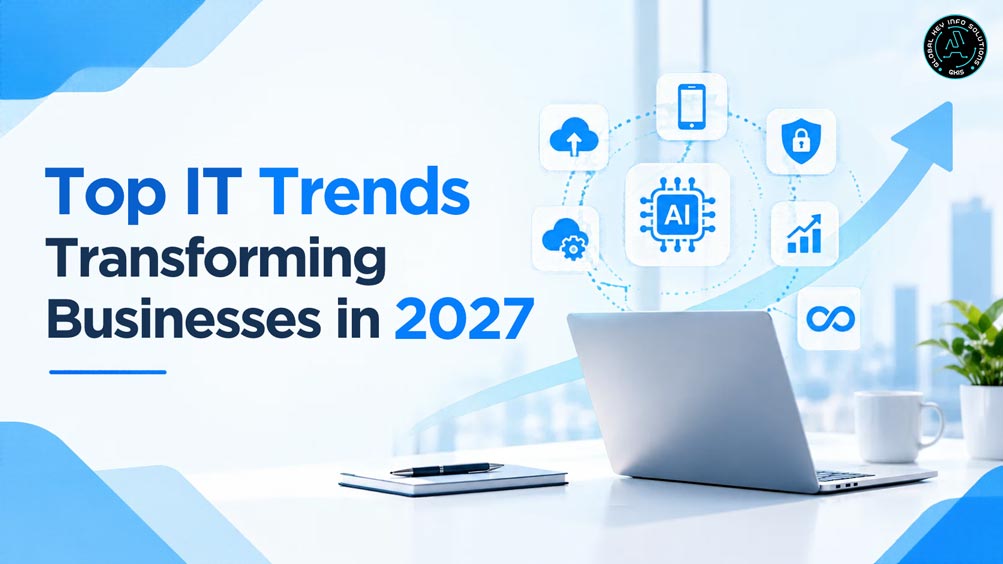
Technology is no longer a support function. For most organisations it is now the operating layer of the business. As 2027 approaches, the question for leaders has shifted from whether to adopt AI, cloud and automation to how to govern, secure and pay for them. Gartner’s top strategic technology trends for 2027, announced in October 2026, reflect that shift: less excitement about generative AI, more focus on control, accuracy, identity, resilience and energy use.
Read More: Best IT Consulting Services in India for Startups and Enterprises
At Global Key Info Solutions (GKIS), we work with businesses on AI and machine learning, cloud infrastructure, custom software and enterprise systems, so these shifts show up in our project conversations every week. This guide covers the IT trends most likely to transform businesses in 2027, the data behind them, and what they mean for your IT services, AI development and digital transformation plans.
Why IT Trends Matter More in 2027
Digital transformation spending keeps rising. Mordor Intelligence puts the digital transformation market at USD 4.46 trillion by 2030. Returns, however, are uneven. IBM points to McKinsey research showing that organisations that launched digital transformations saw only about a third of the expected revenue benefits on average, and stresses that transformation covers culture and organisation as well as technology. Choosing the right trends, and the right IT services partner, matters as much as choosing the right tools.
Three forces explain the urgency. AI is now embedded in mainstream business software, so competitors can automate faster. Cloud and data platforms put advanced capabilities within reach of companies of every size, which lowers the barrier for new challengers. And security and regulatory pressure keeps rising, so weak foundations cost more when they fail. The sections below cover each trend, its business impact and the IT services that support it.
1. Agentic AI and AI Development Move into the Core
AI has moved from pilot to infrastructure. Grand View Research values the global AI market at USD 390.9 billion in 2025 and projects USD 3,497.3 billion by 2033, a 30.6% CAGR. The fastest-moving segment is agentic AI: systems that plan, decide and act towards a goal with limited human intervention. MarketsandMarkets expects the agentic AI market to reach about USD 93.2 billion by 2032.
Businesses already apply agents in customer service, claims processing, fraud detection, predictive maintenance, threat detection and supply chain optimisation. Generative AI runs alongside them for personalised marketing, content and smarter chatbots.
For buyers of AI development services, the scope has widened. It is no longer only about building a model. It includes integrating agents with ERP, CRM and data platforms, setting guardrails and controlling run costs. Gartner warns that through 2027, enterprises running AI agents in IT operations on uncapped, token-based pricing will exceed initial cost expectations by more than 50%. We advise clients to set usage limits and monitoring before an agent goes into production, not after the first invoice.
2. AI-Ready Data, Context and Predictive Analytics
Agents are only as reliable as the data behind them. Gartner’s 2027 list includes AI context platforms, the semantic layer that helps agents interpret inputs and act in line with business goals. Gartner says organisations that prioritise semantics in AI-ready data can raise agentic AI accuracy by up to 80% and reduce costs by up to 60%. It also lists large quantitative models, designed for numerical work where general-purpose language models can produce probabilistic errors, a real concern in finance and healthcare.
Explore More: How IT Consulting Services Aid SMEs’ Growth in India
On the analytics side, modern data platforms such as Snowflake, Databricks and BigQuery make data-driven decisions accessible to companies of every size. Business intelligence is also turning predictive, forecasting demand, churn and inventory rather than only reporting the past. Gartner research also links stronger business value to chief data officers being involved in goal-setting. The practical lesson: invest in data engineering and governance before scaling AI.
3. AI Agent Identity, Zero Trust and Autonomous Security
Every new connected system widens the attack surface. IBM’s Cost of a Data Breach report 2026 puts the global average breach cost at USD 4.99 million, with AI-driven attacks up 56%. Gartner’s 2027 trends respond in three ways:
- AI agent identity: Gartner forecasts that by 2028, 25% of enterprise security breaches will trace back to AI agent abuse caused by unmanaged machine privileges and legacy credentials. Dynamic, policy-controlled access replaces static credentials.
- Autonomous exposure remediation: AI tools that find, rank and fix vulnerabilities, including deploying patches or virtual patches in production.
- AI agent coding harness: a closed-loop control system governing autonomous developer agents across the software development lifecycle.
Proven practices still apply: zero trust architecture, multi-factor authentication, endpoint protection and the “shift-left” approach IBM describes, where security is built into the development cycle. Compliance with GDPR, HIPAA and India’s DPDP Act should be a design input from day one.
4. Cloud, Multi-Cloud, Edge and Sovereign Tech
Cloud is the default, so the conversation has moved to architecture and cost. Synergy Research Group’s Q2 2026 data shows AWS with 28% of global cloud infrastructure spending, Azure 20% and Google Cloud 15%. Because the market is concentrated, enterprises are adopting multi-cloud strategies for resilience and cost flexibility. Gartner expects more than 50% of enterprises to use industry cloud platforms by 2027.
Two additions matter for 2027. First, edge computing processes data close to devices, cutting latency and bandwidth use, which makes it a natural fit for IoT and real-time workloads. Second, Gartner’s sovereign tech trend covers hardware, software, databases and AI models designed to give organisations realistic exit options from critical providers. Gartner expects more than 75% of organisations outside the United States to adopt digital sovereignty strategies by 2030. Cloud computing services and DevOps engagements should now include portability, FinOps-style cost control and exit planning.
5. Hyperautomation, Low-Code and Disposable Applications
Automation is spreading from single tasks to whole workflows. Robotic process automation already handles order processing, inventory updates and customer issue resolution, and teams are extending it to onboarding, invoice approvals and document processing. Combined with AI, this is what the industry calls hyperautomation: automating end-to-end processes rather than isolated steps.
Low-code and no-code platforms extend this by letting business users build apps, workflows and dashboards without waiting for a full development cycle. Gartner’s disposable applications trend goes further: purpose-built apps retired once their job is done, which changes how software is bought, designed and budgeted.
Architecture is following. Composable designs built on microservices and APIs let businesses swap components without rebuilding whole systems, and modernising legacy platforms in stages carries less risk than a single large replacement. For custom software development, that favours modular builds that can change in days instead of months.
6. Digital Twins, IoT and World Models
A digital twin is a virtual replica of a physical process, fed by IoT sensors, that lets teams simulate changes before touching the real system. The main benefits are efficiency, lower cost and reduced risk, and manufacturing and logistics are the most common starting points. IoT supplies the data: MarketsandMarkets projects the global IoT market growing from USD 547.8 billion in 2025 to USD 865.2 billion by 2030. Gartner’s world models extend the idea, giving machines a physics-first understanding of space, time and causality so agents can predict consequences before acting.
7. Personalisation, Voice AI and Sustainable IT
Customers expect experiences shaped by their behaviour. AI and real-time analytics now power tailored recommendations, journeys and faster support. Voice is the next frontier. Gartner calls voice the enterprise’s highest-volume interaction channel, and its speech reasoning models, which reason directly on audio and keep context through a conversation, aim to make complex, judgment-heavy calls automatable.
Sustainability is now a cost and brand issue. Major cloud providers offer carbon tracking tools, and green cloud practices and energy analytics are moving into standard IT planning. Energy demand from AI is also why Gartner lists wetware as a service, an experimental idea of cloud access to biological systems for computation. For most businesses, efficient infrastructure and sensible workload placement come first.
8. Watch List: Quantum, Blockchain and Extended Reality
Most quantum value today lies in planning ahead, with post-quantum cryptography the practical starting point, since quantum computing could eventually break traditional encryption. Blockchain has matured into supply chain transparency, digital identity and smart contracts. Extended reality is moving into training, remote collaboration and virtual showrooms. Treat these as selective bets and adopt them only where a clear use case exists.
2027 IT Trends at a Glance
|
Trend |
Business impact |
Related IT service |
|
Agentic AI |
Autonomous workflows, less manual effort |
AI development services |
|
AI-ready data and context |
Higher accuracy, lower AI cost |
Data engineering, analytics |
|
Agent identity and zero trust |
Lower breach exposure |
Cybersecurity, DevSecOps |
|
Multi-cloud, edge, sovereign tech |
Resilience, less lock-in |
Cloud migration, DevOps |
|
Hyperautomation and low-code |
Faster delivery, fewer errors |
Custom software development |
|
Digital twins and IoT |
Simulation, predictive maintenance |
IoT development |
How Businesses Can Prepare
Start with outcomes, not tools. Before approving any initiative, check three things: does it support a business goal, is the organisation operationally ready for it, and does the cost make sense over time. Next, fix data foundations and treat AI agents as identities with managed permissions. Put cost controls on cloud and AI usage from the start, and modernise legacy systems gradually. Finally, invest in skills: AI literacy, cybersecurity awareness and adaptability matter across the whole team, not only in IT. Pilots typically take weeks, operational integration months and strategic transformation years, so begin with one focused use case and expand once value is proven.
A simple sequence keeps this practical. In the first quarter, audit data quality, identity and access, and cloud spend. Over the next two quarters, pilot one agentic AI or automation use case with measurable targets. After that, scale what works and retire what does not. This ties AI development, cloud and security investment to results instead of experiments.
How GKIS Can Help
The trends above cut across AI, cloud, security and software engineering, so most businesses need a partner that can join them up. GKIS provides AI and machine learning development, custom software development, cloud infrastructure, ERP and CRM, mobile app development and UI/UX services for clients in the USA, UK and UAE. Whether you need an AI development roadmap, a cloud migration plan or a modular rebuild of a legacy system, talk to the GKIS team about your 2027 technology priorities.
Conclusion
The IT trends transforming businesses in 2027 point in one direction: powerful AI needs strong foundations. Organisations that get their data, security, cloud architecture and governance right will extract far more value from AI development and automation than those that chase tools alone. Pick the trends that fit your business model, pilot them, and scale what works.
6a6878decb3ee.jpg)



0 Comments
Leave a comment