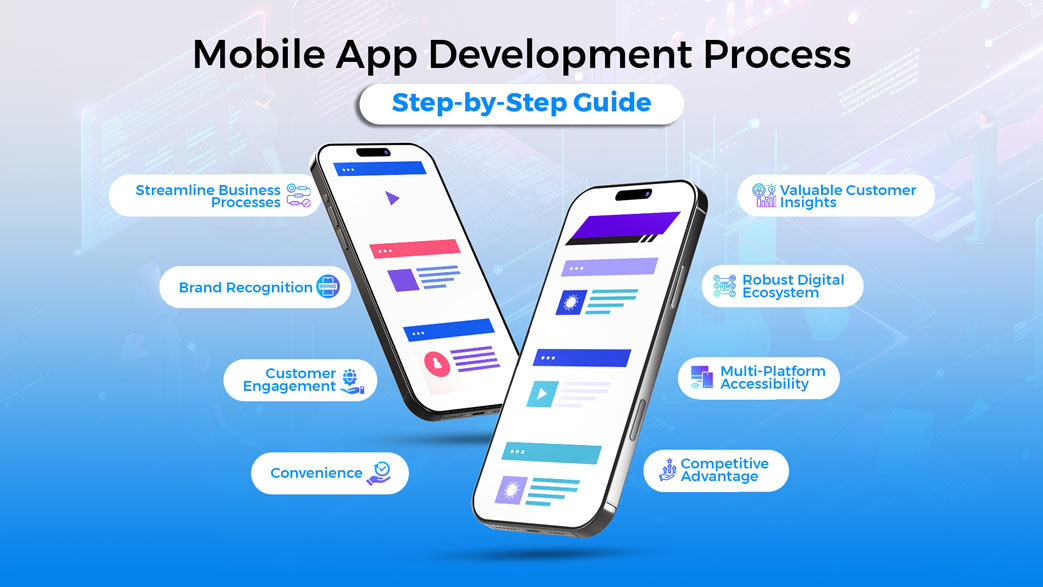
Building a mobile app is one of the most impactful decisions a business can make today. Whether you are a startup testing a new idea or an established enterprise looking to digitise operations, understanding the mobile app development process from start to finish can save you time, money, and a great deal of frustration.
At Global Key Info Solutions (GKIS), we have helped businesses in India, turn their ideas into market-ready digital products. Over the years, one thing has become clear the companies that succeed with their apps are the ones that follow a structured, well-planned development process.
Read Also: Mobile App Development for Startups
This guide walks you through every stage of that process in plain language, so you know exactly what to expect before, during, and after your app goes live.
Why the Mobile App Development Process Matters
A poorly planned app costs more than a well-planned one always. Skipping stages, rushing design, or starting development without proper business analysis leads to bloated budgets, missed deadlines, and products users simply don't engage with.
The global mobile app market is projected to exceed $600 billion in revenue by 2026, and with over 6.3 billion smartphone users worldwide, the opportunity is enormous. But so is the competition. A clear, repeatable development process is what separates apps that scale from apps that stall.
Why Invest in Mobile App Development? Benefits for Businesses
Many business owners ask a fair question before committing to app development: is it actually worth the investment? The answer, for most businesses operating in 2026, is yes but the reasoning goes well beyond simply "everyone has a smartphone."
Here is what a well-built mobile app genuinely delivers for businesses:
-
Direct Channel to Your Customers
A mobile app gives you a line of communication that no algorithm can cut off. Unlike social media where organic reach fluctuates, or email where open rates have declined, push notifications reach users directly on their lock screens. Businesses that use personalised push notifications see up to 3x higher engagement compared to email campaigns alone.
-
Stronger Brand Presence
Your app sits on your customer's phone, often alongside apps they use every single day. That constant visibility builds familiarity and trust in a way that a website simply cannot replicate. Every time a user unlocks their phone, your brand is there.
-
Higher Revenue Potential
Mobile apps open multiple revenue streams that a website cannot easily support in-app purchases, subscription tiers, premium feature unlocks, loyalty rewards, and seamless one-tap payments. Businesses with dedicated mobile apps consistently report higher average order values compared to mobile web transactions, largely due to a smoother checkout experience.
-
Improved Customer Retention
Acquiring a new customer costs five to seven times more than retaining an existing one. A well-designed app with personalised experiences, loyalty programmes, and frictionless service keeps customers coming back. Apps with strong onboarding and engagement flows achieve Day-30 retention rates of 25–32%, compared to single-digit rates for poorly designed products.
-
Valuable Business Intelligence
Every interaction inside your app generates data. Which features do users engage with most? Where do they drop off? What time of day are they most active? This intelligence feeds directly into smarter product decisions, better marketing targeting, and more effective sales strategies. Businesses that act on in-app analytics consistently outperform those making decisions based on gut instinct alone.
-
Operational Efficiency
For many businesses, a mobile app is not just a customer-facing product it is an internal operations tool. Field service teams, delivery drivers, healthcare workers, and retail staff can all benefit from custom mobile solutions that eliminate paper-based processes, reduce manual errors, and surface real-time information exactly when it is needed.
-
Competitive Advantage
In many sectors, having a mobile app is now table stakes. In others, it is still a genuine differentiator. Either way, businesses without a mobile presence risk losing ground to competitors who are investing in digital experiences. The question is no longer whether to build an app it is how to build one that actually works.
Key Considerations Before Starting the App Development Process
Before your first line of code is written or even before your first design is sketched there are several important decisions that will shape everything that follows. Getting these right at the start saves significant time and money later.
Define Your Core Objective Clearly
The most common reason app projects go off track is an unclear objective. "We want an app" is not a brief. A useful objective sounds more like: "We want to reduce customer service call volume by 30% by giving users self-service account management on mobile." Specific objectives produce focused products.
Know Your Target Audience in Detail
Age, device preference, technical literacy, geography, and daily habits all influence how your app should be designed and what features it needs. An app built for 55-year-old rural healthcare workers needs to be designed very differently from one built for 25-year-old urban e-commerce shoppers even if the underlying functionality is similar.
Set a Realistic Budget and Add a Buffer
Most first-time app owners underestimate development costs, not because developers charge too much, but because the full scope of what is involved is not always visible upfront. Budget for discovery, design, development, testing, launch, and at least 6 months of post-launch support. Add a 15–20% contingency buffer for scope changes they almost always happen.
Decide on Build Approach: In-House, Freelance, or Agency
Each option has real trade-offs:
|
Approach |
Pros |
Cons |
|
In-house team |
Full control, deep product knowledge |
High cost, slow to hire, hard to scale |
|
Freelancers |
Lower cost, flexible |
Coordination challenges, inconsistent quality, no accountability |
|
Development agency |
End-to-end expertise, structured process, accountability |
Higher upfront cost than freelancers |
For most businesses building their first or second app, a specialist agency like GKIS offers the best combination of structured process, technical depth, and risk management.
Understand Your Compliance and Security Requirements
Depending on your industry and geography, your app may need to comply with specific regulations GDPR for European users, HIPAA for healthcare data in the USA, PCI-DSS for payment processing, or India's DPDPA (Digital Personal Data Protection Act). Identifying these requirements before development starts ensures they are built in by design, not bolted on later.
Plan for the Long Term, Not Just the Launch
The launch is a milestone, not the finish line. Apps that succeed long-term are treated as living products continuously updated, improved, and expanded based on user feedback and market changes. Before you start, make sure you have a plan (and a budget) for what comes after launch.
Choose the Right Development Partner
This is arguably the most important consideration of all. The partner you choose will influence not just the quality of the final product, but the entire experience of building it the communication, the transparency, the problem-solving when things get complex. Look for a team that asks good questions, pushes back constructively when needed, and has a track record of delivering products similar to yours.
The 8-Stage Mobile App Development Process at GKIS
Stage 1 — Discovery & Strategy
Every successful app starts not with code, but with clarity. The discovery stage is where your idea gets stress-tested against the real world.
At GKIS, our first conversation with any client centres on three core questions:
- What problem does this app solve?
- Who exactly is the target user?
- What does success look like in 6 months, 12 months, and beyond?
This is also where we conduct competitive research analysing existing apps in your space to understand what works, what doesn't, and where your opportunity lies.
Platform selection is another critical decision made here. Should you build a native iOS app, a custom Android solution, or a cross-platform app that serves both ecosystems from a single codebase? The right answer depends on your audience, budget, and growth timeline. For most startups and growing businesses, cross-platform development with React Native or Flutter offers the best balance of cost and performance.
Check Now: Mobile app Development Trends
Finally, if you are building a consumer-facing product, we help you define your monetisation model whether that is subscriptions, in-app purchases, freemium upgrades, or advertising.
Key outputs from Stage 1:
- Defined problem statement and target audience
- Competitor analysis report
- Platform recommendation
- Monetisation strategy
Stage 2 — Business Analysis & Planning
Once the strategy is clear, it is time to get precise. This is where our business analysis services come in translating your vision into documented requirements that the design and development teams can actually build from.
We create two types of requirement documents:
Functional Requirements define what the app must do login and registration, payment processing, push notifications, search functionality, user profiles, and so on.
Non-Functional Requirements define how the app must perform speed, uptime, security, scalability, and accessibility standards.
From these documents, we build a product roadmap that prioritises features into logical development phases. This is where the concept of an MVP (Minimum Viable Product) becomes central. Rather than building every feature on day one, we identify the smallest version of your app that delivers real value to users and can be tested in the market.
This approach reduces risk, shortens your time to market, and gives you real data to make smarter decisions about what to build next.
Key outputs from Stage 2:
- Functional & non-functional requirements document
- Product roadmap
- MVP feature scope
- Project timeline and resource plan
Stage 3 — UI/UX Design
Design is not decoration — it is strategy made visible. A well-executed UI/UX design process determines how users feel about your app from the first tap to the hundredth session.
Our design process at GKIS follows a structured flow:
User Research & Personas — Before any screen is drawn, we study your target users. What devices do they use? What frustrates them about existing apps? What tasks are they trying to complete?
Information Architecture — We map out the full structure of the app: every screen, every flow, every decision point. This becomes the blueprint for everything that follows.
Wireframes — Low-fidelity sketches of each screen showing layout and functionality without visual styling. These are fast to produce and easy to revise which is exactly the point.
Interactive Prototypes — Clickable mockups that simulate the real app experience. Clients can tap through the prototype, test user journeys, and provide feedback before a single line of code is written.
Visual Design — The final high-fidelity screens with brand colours, typography, iconography, and micro-animations applied. This is what your app will look like to users.
In 2026, strong UI/UX design also means building for accessibility, dark mode, gesture-first navigation, and AI-driven personalisation. These are no longer nice-to-haves they are baseline expectations for users.
Key outputs from Stage 3:
- User research findings
- Wireframes for all screens
- Interactive clickable prototype
- Final UI design files (Figma)
- Design system and component library
Stage 4 — Technology Planning & Architecture
Before development begins, the engineering team defines the technical foundation the app will be built on. Choosing the wrong technology stack at this stage is one of the most expensive mistakes a business can make it can mean a complete rewrite 18 months later.
At GKIS, our technology recommendations are driven by three factors: your current needs, your projected scale, and your budget.
Common technology choices we work with:
|
Layer |
Options |
|
Cross-platform development |
React Native, Flutter |
|
Native iOS |
Swift, SwiftUI |
|
Native Android |
Kotlin, Jetpack Compose |
|
Backend |
Node.js, Python (Django/FastAPI), Ruby on Rails |
|
Database |
PostgreSQL, MongoDB, Firebase |
|
Cloud Hosting |
AWS, Google Cloud, Microsoft Azure |
|
AI Integration |
OpenAI APIs, TensorFlow, custom ML models |
AI-based mobile app development is now a core consideration, not an afterthought. From intelligent search and personalised recommendations to automated customer support and predictive analytics, AI features are increasingly what differentiate high-performing apps from average ones. Our team has experience integrating AI capabilities into mobile products across healthcare, e-commerce, logistics, and fintech.
Key outputs from Stage 4:
- Recommended technology stack document
- System architecture diagram
- Database schema design
- API design and integration plan
- Security and compliance framework
Stage 5 — Development (Frontend + Backend)
This is where your product comes to life. Development at GKIS runs in two-week Agile sprints, with working software delivered at the end of every sprint so you can see real progress and provide feedback continuously.
Frontend development covers everything the user sees and interacts with the screens, animations, navigation, and interactions defined during the UI/UX design stage.
Backend development covers the server-side logic, databases, APIs, and third-party integrations that power what happens under the hood user authentication, data storage, payment processing, notification systems, and more.
Throughout development, our team follows strict coding standards, conducts regular code reviews, and maintains comprehensive documentation. We also integrate version control (Git) and continuous integration pipelines from day one, so the codebase stays clean and deployable at all times.
For clients requiring a website development process alongside their app for example, a companion admin panel or a marketing website we handle both in parallel to ensure consistency in design and architecture.
Key outputs from Stage 5:
- Fully functional frontend application
- Robust, secure backend APIs
- Third-party integrations (payments, maps, analytics, etc.)
- Admin dashboard (where applicable)
- Sprint review demos and progress reports
Stage 6 — Quality Assurance & Testing
An app that crashes, lags, or behaves unexpectedly is worse than no app at all. Testing is not something we do at the end it runs in parallel with development throughout every sprint.
Our QA process covers:
Functional Testing — Does every feature work as specified in the requirements document?
Performance Testing — How does the app behave under load? Does it remain fast and stable with 100 users? 10,000?
Security Testing — Are user data and transactions properly protected? We test for common vulnerabilities including SQL injection, insecure APIs, and improper session management.
Compatibility Testing — Does the app work correctly across different devices, screen sizes, and operating system versions?
Regression Testing — When new features are added, do they break anything that was working before?
User Acceptance Testing (UAT) — Real users test the app in a controlled environment before launch. This is often where the most valuable insights surface.
We also conduct a beta launch with a small, targeted audience to gather real-world feedback and fix any issues before the full public release.
Key outputs from Stage 6:
- QA test plan and test cases
- Bug tracking and resolution reports
- Performance benchmark results
- Security audit report
- UAT sign-off
Stage 7 — Deployment & Launch
With testing complete and sign-off received, it is time to release your app to the world. Deployment involves submitting your app to the Apple App Store and Google Play Store, each of which has its own review process and technical requirements.
Our team handles the entire submission process, including:
- App store listing optimisation (ASO) — title, description, screenshots, keywords
- Compliance with Apple and Google guidelines
- Setting up analytics and crash reporting tools
- Configuring production servers and monitoring dashboards
- Coordinating the launch with your marketing and communications team
A well-planned launch is as important as a well-built app. We help clients coordinate soft launches (releasing to a limited geography or audience first) to validate performance before scaling globally.
Key outputs from Stage 7:
- App published on App Store and Google Play
- Optimised store listing
- Production monitoring configured
- Launch checklist completed
Stage 8 — Post-Launch Support & Continuous Improvement
Launching your app is the beginning of the journey, not the end. The best mobile products in the world are constantly evolving based on user feedback, analytics data, and market changes.
At GKIS, our post-launch support includes:
- Performance monitoring — tracking uptime, crash rates, API response times, and user-reported issues
- Regular updates — OS compatibility updates, security patches, and performance improvements
- Feature development — building the next phase of your product roadmap based on real user data
- Analytics review — monthly reporting on key metrics including retention rate, session length, conversion rate, and revenue
We also help clients identify opportunities to integrate new technologies over time whether that is adding AI-based features, expanding to new platforms, or building integrations with third-party services.
Key outputs from Stage 8:
- Monthly performance reports
- Ongoing bug fixes and patches
- Feature roadmap for next development phase
- User feedback analysis
How Long Does the Mobile App Development Process Take?
|
App Type |
Estimated Timeline |
|
Simple MVP (5–8 features) |
8–12 weeks |
|
Medium complexity app |
16–24 weeks |
|
Enterprise-grade application |
6–12 months |
Timelines vary based on the number of features, complexity of integrations, and the availability of client stakeholders for feedback and approvals.
How Much Does It Cost?
|
App Type |
Estimated Cost (INR) |
|
Basic MVP |
₹3,00,000 – ₹8,00,000 |
|
Mid-complexity app |
₹8,00,000 – ₹20,00,000 |
|
Enterprise / AI-powered app |
₹20,00,000 and above |
Cost is influenced by the number of screens, backend complexity, third-party integrations, and whether you need a custom Android solution, iOS app, or both.
Common Mistakes to Avoid in the App Development Process
Skipping the discovery stage: Building without a validated strategy is the fastest route to a product nobody uses.
Underinvesting in UI/UX design: Users judge apps in seconds. Poor design leads to immediate uninstalls.
Ignoring security from the start: Retrofitting security is far more expensive than building it in from day one.
Building everything in V1: More features do not equal a better product at launch. Start lean, learn fast, then build more.
Choosing the cheapest development partner: The cost of fixing a poorly built app almost always exceeds the money saved upfront.
Why Choose GKIS for Your Mobile App Development?
Global Key Info Solutions brings together experienced product strategists, designers, engineers, and QA specialists who have delivered 100+ digital solutions across startups and enterprises.
We offer end-to-end mobile app development from initial discovery and UI/UX design to development, testing, launch, and ongoing support. Whether you need a custom Android solution for a specific industry, an AI-based mobile app for intelligent user experiences, or a full-scale cross-platform product, our team has the expertise to deliver.
Our process is transparent, collaborative, and built around your business goals not just your feature list.




0 Comments
Leave a comment