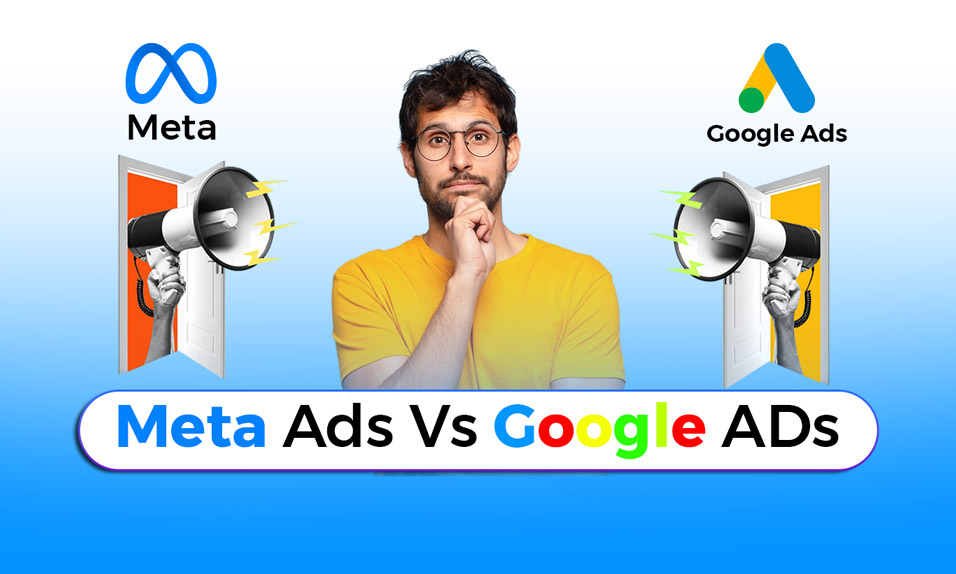
Google Ads and Meta Ads remain the most popular paid media platforms in 2025-26. To maximize Return on Investment (ROI), a Digital Marketing Company must select the appropriate channel, or combination of channels. While Meta Ads thrives on interest-based discovery and engages audiences visually as they scroll through feeds and reels, Google Ads prioritizes intent-driven marketing, reaching users who are actively looking for solutions. Understanding these fundamental distinctions is essential for companies seeking to allocate their advertising budget effectively, as they influence ROI on each platform.
Read More: PPC Management Services in India
Both platforms have significant benefits, but how well they work will largely depend on your business objectives, audience intent, ad formats, and overall campaign strategy. Here's an in-depth comparison that will help you make more informed choices.
Google Ads Overview: Intent-Driven Advertising for High ROI
Google Ads is a potent online advertising tool that enables companies to connect with potential clients right when they are looking for goods or services. Because Google Ads is based on user intent, it remains a key performance channel for any digital marketing company. This is because it is a highly effective tool for increasing visibility in competitive markets, generating leads, and driving sales. With billions of searches daily, Google Ads enables brands to appear on websites, mobile apps, YouTube, and Google Search, ensuring a strong presence throughout the customer journey.
Key Strengths
Google Ads has many fantastic qualities that make it an excellent choice for businesses to advertise with:
Intent-Based Targeting: Reaching individuals who are actively searching for your product or service and will increase conversion rates by getting your ad in front of them at the exact moment they are ready to buy.
Lead generation: With search-driven traffic and high conversion rates, you have the best chance of generating leads or sales from Google Ads.
Multiple Ad Formats: Google Ads offers a range of advertising formats; you can advertise on Display, Search, Shopping, YouTube (Video), Apps, and Performance Max for any Customer Group.
Advanced AI & Smart Bidding: Utilizes real-time data through machine learning to optimize your bidding for maximum performance and cost efficiency.
Precise Keyword Setting: Providing advertisers greater flexibility in targeting, refining, and excluding keywords to reach their most relevant audiences.
Tracking/Analytics: Easily integrates with Google Analytics, so you can easily receive accurate measurements of your clicks and conversions and calculate your ROI.
Scalable Campaigns: Facilitating easy budget adjustment, making Google Ads a suitable marketing tool for both small businesses and large corporations.
Local/Global Reach: Enables you to target by location, device, language, and time, delivering the best possible internet ads.
Meta Ads Explained: Visual, Interest-Based Advertising at Scale
Businesses can leverage the Meta Ads platform to maximize their visibility, engagement, and long-term growth. Unlike search-based channels, Meta Ads are consumer interest-based and behaviour-based advertising across Facebook, Instagram, Messenger, and the Meta Audience Network. They allow brands to reach customers before they start searching for something (i.e., before they have a “purchase intent”). As a result of this trend, Meta Ads will remain an essential part of digital marketing strategies in the coming years, particularly as more brands rely on visual narratives to influence purchase decisions.
Key Strengths
Businesses aiming to increase brand exposure and brand loyalty can use Meta Ads because of its following features:
Interest and behaviour-based targeting - You can reach users based on their demographics, interests, behaviours, and online activities.
Engaging ad formats - Supports animations (like reels and stories), videos, carousel, and collection formats that provide strong visual appeal.
Brand recognition - Strong advertising medium to build brand recognition and trust for a long-term audience.
Lower Cost Per Click: CPCs are generally lower than those for other Search Ads, making it a more affordable search advertising option.
Massive audience reach: Billions of users globally reached via Facebook and Instagram.
Advanced retargeting options: Enable remarketing to active users to increase conversion rates.
Google Ads vs Meta Ads: Key Differences in ROI, Cost & Funnel Stage
The difference between Google Ads and Meta Ads goes beyond platform superiority and is about their potential to achieve specific marketing goals. Both form the basis of modern digital marketing strategies, yet play distinct roles.
Google Ads excels at identifying current customer needs. Users who search for keywords demonstrate active interest, leading to faster, more predictable conversion results. Service-based businesses, along with local searches and products showing high purchase intent, find Google Ads to be their perfect match. The ROI from each conversion tends to be higher, but businesses have to pay high entry fees because they must compete with other bidders for the same spots.
Meta Ads focuses its marketing efforts on generating product demand. The platform allows users to discover products during their first buying stage through its visual content and storytelling approach. This creates multiple product exposures that impact their purchasing decisions. Businesses can establish brand trust through Meta Ads, which build customer familiarity and long-term brand value at a reduced cost per click, even though they do not produce immediate sales.
Below is a side-by-side comparison of Google Ads vs Meta Ads to help businesses choose the right platform based on ROI, intent, and funnel stage.
Parameter |
Google Ads |
Meta Ads |
|
Primary Focus |
Captures current demand by tracking search activities |
Generates new demand through interest-based discovery |
|
User Intent |
High users are actively searching for solutions |
Medium – users are browsing social platforms |
|
Conversion Potential |
Better conversion rates because visitors show clear purchase intentions |
Strong assisted conversions because of profound customer relationship growth |
|
Cost Per Click (CPC) |
Generally high because it functions in multiple competitive business sectors |
Typically lower and delivers financial advantages to its customers |
|
Best Funnel Stage |
Bottom of the funnel (leads & sales) |
Top and mid-funnel (awareness & engagement) |
|
Ad Formats |
Search, Display, Shopping, YouTube, Performance Max |
Reels, Stories, Video, Carousel, Lead Ads |
|
Targeting Method |
Keyword, location, device, demographics |
Interests, behaviors, demographics, lookalikes |
|
Speed of Results |
The process delivers results at an accelerated pace, which leads to quick financial returns |
The process produces results gradually with a long-term impact |
|
Tracking & Attribution |
Robust and transparent tracking scenario via Google Analytics |
It needs a complex configuration for its Pixel and CAPI components |
|
Brand Awareness |
The search ads show only basic visual elements to represent the brand |
Serves as an excellent platform for brands to present their visual content and storytelling elements |
|
Scalability |
Highly scalable with flexible budgets and a greater possibility to handle growing business needs |
Handles growth effectively with creative content and audience expansion |
|
Best Use Case |
Lead generation, local services, high-intent sales |
Brand building, engagement, and remarketing |
Conclusion
Both (Google & Meta) have different yet significant roles in generating ROI. Google Ads drives high-intent traffic, while Meta Ads builds awareness and drives engagement. Together, they form a potent full-funnel approach. To develop data-driven ad campaigns, partner with our digital marketing company in India. We strategically convert clicks/attention into tangible business results.
FAQs
Google Ads vs Meta Ads: Which platform is better for ROI?
The most successful digital marketing firms are no longer deciding between one platform and another; they are using Meta + Google Synergy.
Key benefits of the two-way approach:
- Use Meta Ads to spark interest and build brand recognition through compelling visuals and social proof.
- Use Google Ads to capture and convert interest when users are actively searching or ready to buy.
Which platform has better ROI for a digital marketing company?
For a digital marketing firm, Google Ads offers a quicker ROI for high-intent searches, while Meta Ads provides an affordable way to reach and engage users. The most effective ROI is achieved by leveraging both platforms, creating demand with Meta and then converting it with Google.
Can small businesses use both Google Ads and Meta Ads?
Yes, small businesses can significantly benefit from using both platforms together. Meta Ads can build brand awareness and engage potential customers early, while Google Ads can reach high-intent users who are ready to take action.
How long does it take to see ROI from these platforms?
Google Ads can deliver faster ROI because it targets users actively searching for solutions to their problems, and results can be seen in days or weeks. Meta Ads will take longer because they are used to create awareness and engagement first.





0 Comments
Leave a comment