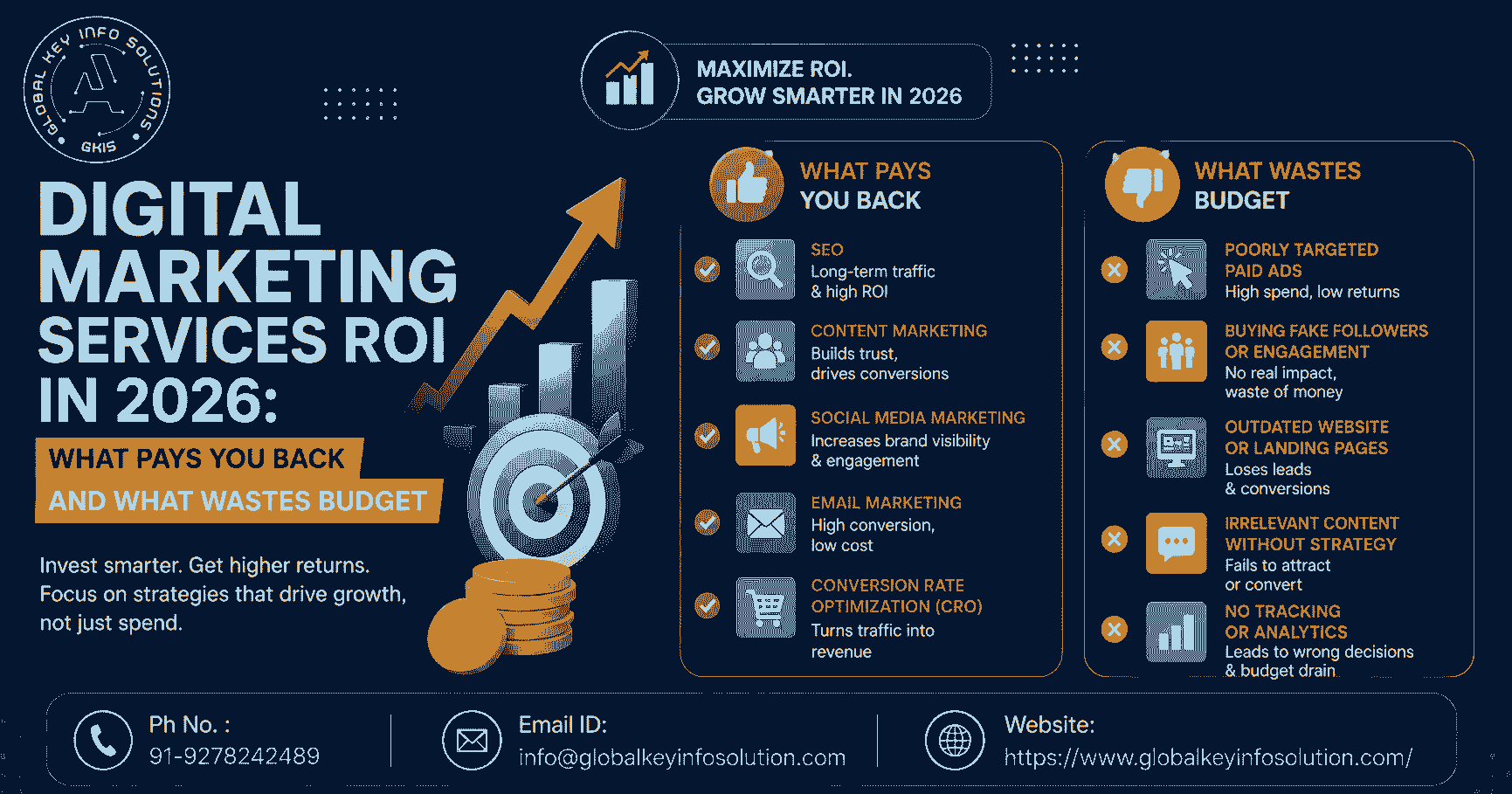
Businesses that invest in digital marketing share the same worry: Does this really work? Not every digital marketing service delivers the same return. Some channels grow over time and continue to generate leads even after the investment. Other people burn through their budget fast, cause brief spikes in traffic, and then leave nothing. Being aware of the difference is not just a useful piece of information for 2026; it's the difference between stalling and growing.
This guide breaks down every major digital marketing service in India by what it actually costs, what it realistically delivers, and whether your business should invest in it right now. Each figure is derived from the latest industry data.
Why ROI Varies So Much Across Digital Marketing Channels
Before making comparisons between channels, it is helpful to know why the ROI figures are different for different digital marketing channels.
Certain channels, including SEO, Content marketing and email, create resources over the course of time. The returns increase the more you put into it. Other channels, such as paid search and paid social, deliver results even when the budget is in operation and cease at the point you put a stop to spending. The two approaches are not incompatible. They have different functions and are most effective when they are combined.
Based on HubSpot's State of Marketing Report 2026, the blog, website SEO, and blogs were ranked as the highest ROI-generating channels among marketers that were surveyed. They are being followed by the paid and organic social networks, as well as content on social. Marketing through email is the best in terms of ROI, especially in the category of B2C marketers.
The companies that are generating the highest results aren't relying on a single channel. They combine short-term channels to get immediate leads and long-term channels that create compound value. This is the reason why the digital marketing strategy helps grow a business from one that simply keeps the lights on.
The ROI Benchmark Table: Every Major Channel at a Glance
Here's how the major digital marketing channels measure up to ROI, based on the 2026 benchmarks for the industry:
| Channel | Average ROI | Returns Timeline | Best For |
| Email Marketing | $36–$42 per $1 spent | Short to medium term | B2C, e-commerce, repeat customers |
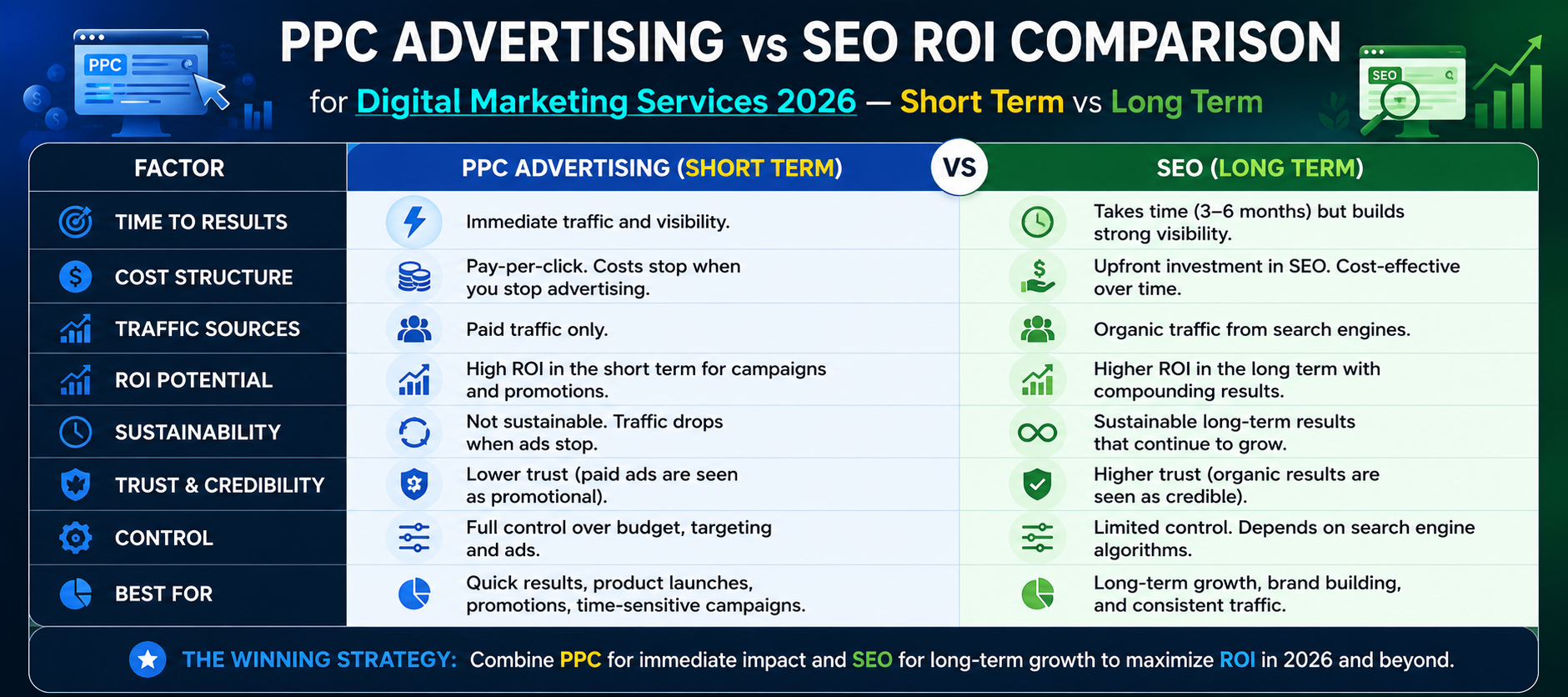
| SEO | 700%+ over 3 years | Long term (3–6 months to build) | All business types |
| PPC (Google Ads) | 200% average | Immediate | Businesses needing fast leads |
| Content Marketing | 3x more leads than outbound | Medium to long term | B2B, service businesses |
| Social Media (Organic) | Variable, hard to measure directly | Long term | Brand awareness, community |
| Paid Social (Meta, LinkedIn) | $2–$5 per $1 spent | Short term | Targeted awareness and retargeting |
| Video Marketing | Highest ROI of any content format | Medium term | Product-led businesses, e-commerce |
SEO: The Highest Long-Term ROI Digital Marketing Service
If you want the single digital marketing investment that pays the most over time, SEO services are the answer, with one important condition. It takes time.
SEO leads close at a 14.6% rate. Outbound leads, cold calls, paid lists, and interruptive ads close at 1.7%. That is not a small gap. That is a fundamental difference in the quality of the person arriving at your business. Someone who found you through organic search was already looking for what you offer. That intent converts at a completely different rate.
According to data from First Page Sage, B2B SEO campaigns delivered an average ROI of 748% over three years. For businesses willing to invest consistently for six months or more, that return is difficult to match through any other channel.
The truth about SEO is that results don't begin to appear until the very first month. Businesses that try SEO over a period of 90 days and find that there is no movement and decide to cut their budget will conclude that SEO doesn't work. The companies with the 700% return are ones that have been in the business long enough to allow compounding to be effective.
Based on the 2026 HubSpot State of Marketing Report, 49% of marketers believe that organic search provides the best ROI out of every channel they employ.
PPC Advertising: Strong Immediate ROI, But Only While You're Paying
PPC advertising through Google Ads delivers an average 200% ROI, meaning businesses get back roughly $2 for every $1 spent. For businesses using AI-assisted bidding strategies in 2026, that figure climbs to an average of 287% according to WordStream's Global PPC Benchmark Report.
When you stop the PPC campaign, the traffic ceases. The leads cease. There is nothing that compounds and builds. You're renting visibility instead of owning it. If you are a business that relies exclusively on paid search for the leads it generates, even a budget cut or an abrupt increase in cost per click could cause lead generation to end in a matter of minutes.
PPC works best as a short-term bridge while long-term channels like SEO and content marketing build momentum. It's also great for promotions, launches or seasonal campaigns when you need to increase the volume of your campaigns in a timeframe.
Where PPC spends too much money: Broad Keyword targeting, poorly written ad copy, and sending users to generic websites instead of landing pages specifically designed for them and running campaigns with no regularly scheduled negative keyword control. These four errors alone are responsible for the majority of the wasted PPC spending for medium and small-sized businesses.
Content Marketing: Low Cost, Compounding Returns, and Often Underused
Content marketing costs 62% less than traditional outbound marketing and generates three times more leads. The data from the Content Marketing Institute has held over time because the basic logic behind it doesn't shift: information that addresses genuine questions continues to function even after it has been published.
A well-researched article on a topic your customers are searching for can drive organic traffic, generate email subscribers, support your sales team, and rank in AI search results all from a single investment of time and money. That is the compounding nature of content that paid advertising simply cannot replicate.
Smaller companies are more likely than the average company to reap ROI through blog content, as per the HubSpot 2026 State of Marketing Report. For businesses that provide services, such as web design firms and marketing consultants, as well as accounting and legal firms, practices Content marketing is often the highest ROI channel since it establishes credibility in a particular field that is directly linked to buyer behavior in search.
The biggest mistake that companies make when it comes to content marketing is to publish without a plan. Publishing about subjects that have little or no intent to sell or no connection to what the business actually provides is the reason that so many content programs do nothing quantifiable. Content must be relevant to what the consumer is seeking, at the stage of the buyer journey they are currently in.
Email Marketing: The Highest Short-Term ROI of Any Channel
Marketing via email returns between $36 and $42 per $1 dependent on the industry and quality of the list. This figure has remained high on ROI charts for more than a decade. And in 2026, it is still the same.
What makes email marketing so efficient is that you are marketing to people who have already raised their hand. They gave you their email address. They already know your business exists. The cost of reaching them again is close to zero compared to finding a new audience through paid channels.
61 % of customers prefer to receive communications from companies via email instead of text messages or social media. For B2C companies, email is the most important ROI driver over any other channel. For B2B businesses that have long sales cycles, email nurture sequences can keep warm prospects interested without having to spend money on ads to keep them at the top of their minds.
One condition: your list must be designed correctly. Lists of purchased email addresses are not as effective and pose a risk of compliance under GDPR and the Indian Digital Personal Data Protection Act. A tiny, organically-constructed list of 2,000 genuine subscribers is superior to a paid list of 20,000.
Social Media Marketing: Best for Awareness, Weak for Direct ROI
Social media is the medium in which marketing budgets often disappear with no clear return.
Regular social media posting through Instagram, Facebook, or LinkedIn with no paid advertising builds communities and brand recognition over time. This is of real value. But attributing direct revenue to an organic post is difficult, which makes measuring ROI inconsistent.
Paid social through Meta Ads and LinkedIn Ads delivers roughly $2 to $5 per $1 spent, depending on targeting quality, creative, and industry. It's a less lucrative return than SEO, email, and content marketing; however, paid social offers capabilities that other channels do not. Retargeting people who visited your website, targeting lookalike audiences based on your existing customers, and running awareness campaigns to warm up cold audiences are all meaningful uses of paid social that support the overall marketing system.
The businesses wasting money on social media marketing services are the ones treating it as a standalone lead generation channel. If it is on its own, with the right funnel in place, paid social is a source of visitors that don't always convert on the first visit. As part of a larger digital marketing strategy, which includes targeting, retargeting, and nurturing, it could be a crucial support.
According to HubSpot's report for 2026, brands that have strong engagement across all channels, where social media is a component of a comprehensive strategy, get 89% customer retention as compared to 33% for single-channel brands.
Video Marketing: The Fastest-Growing ROI Format in 2026
Video in short-form has the best return on investment of any format in 2026, as per numerous surveys in the field of marketing. The ad budget for video is expected to exceed $190 billion worldwide this year, and more than 70% of marketing professionals are planning to keep or increase their spending on video.
96% of consumers watch an explanatory video before making a purchase. For companies selling products that require explanation, professional services, software such as technical products, health and wellness, videos can reduce the friction between initial interest buying and purchasing in a manner that text can't.
The good news for smaller businesses: the highest-performing short-form video content in 2026 is not polished production. Authentic, informative, and specific content consistently outperforms high-budget generic material. A 60-second video answering one specific customer question, filmed on a phone with good lighting, can outperform a $5,000 production if it speaks directly to what the viewer needs to know.
The consideration here for investment is not just money; it's reliability. One video is not going to change the direction of. A collection of targeted videos that are searchable and useful, created over six to 12 months, can be a compounding asset that helps SEO solve buyer complaints and establishes trust over time.
How to Allocate Your Digital Marketing Budget in 2026
Knowing which channels pay back is only relevant if you can apply them to a real budget. Here's a useful framework that is based on benchmarks for 2026.
72% of marketing budgets are currently allotted towards digital platforms. Many growing businesses invest between 40 and 60 per cent of their total marketing budget in digital channels. The proportion of that budget is more important than the total amount.
For businesses under 3 years old or with a limited track record online: Prioritise SEO and content marketing as the foundation. Add email list building from day one. Use a small PPC budget for specific campaign needs rather than ongoing lead generation.
Businesses with a reputable customer base and looking to grow to new customers: Increase the use of email marketing. Your list is probably already in place, and it's not being used by the majority of businesses. Spend money on content that targets keywords at the bottom of the funnel that have a buying intention. Use paid social for retargeting your existing website traffic.
For companies operating in highly competitive markets that require immediate exposure, PPC buys time while SEO creates. Search for paid ads on the most profitable keywords while simultaneously investing in SEO content and technical SEO to ensure that organic results eventually take over the dependency on paid advertising.
What should be cut in 2026? Vanity metrics are spent on follower growth campaigns that have no conversion strategy to back them, and display advertising that has no Retargeting, or content production without any keyword or intent to research the subject. These are the three areas where marketing budgets are the most frequently disappear, without producing tangible returns.
5 Signs Your Current Digital Marketing Is Wasting Budget
Run through this list. If three or more apply, your current digital marketing setup has measurable gaps worth fixing.
- You cannot clearly attribute leads or sales to a specific marketing channel.
- Your PPC campaigns send traffic to your homepage rather than dedicated landing pages.
- You have an email list, but send fewer than two campaigns per month
- Your content output has no connection to keyword research or buyer intent
- You are spending on social media, but have no retargeting set up for website visitors
If these sound familiar, the problem is not that digital marketing does not work for your business. The problem is that the current setup is not structured to produce measurable returns.
Is your marketing budget actually paying you back?
Find out which channels are working and which ones are draining your budget.
Get a Free Digital Marketing Audit →Getting the ROI Your Business Actually Deserves
The data is simple. SEO, email and content marketing provide the highest long-term ROI. PPC can generate immediate revenue when properly structured. Video is the fastest-growing form of media. Social media is an additional channel in an integrated strategy, and not as an independent driver.
The companies that are getting the highest ROI in their marketing via digital campaigns are in no way spending less than their rivals. They're spending money on the right channels, evaluating the results they want and constructing assets that are compounding rather than leasing visibility that vanishes when the budget ends.
Global Key Info Solutions is a full-service digital marketing company that collaborates with freelancers, startups, small businesses, and enterprise teams. They focus on developing strategies centred around measurable returns instead of simply measuring activity metrics. Whether you need a complete digital marketing strategy from the ground up, want to fix the channels that are not delivering, or are trying to understand where your current budget is going, our team brings the clarity and execution to make every investment count.




0 Comments
Leave a comment