6a686ac42e4e6.jpg)
The mobile app industry offers hundreds of options to every traveler planning a trip. The rapid rise in online travel booking apps has created a serious question mark over the future of traditional travel agents.
Airlines, hotel chains, and car rental brands have all built their own applications to join the race. This is pushing travel agents further out of the equation every single day.
Launching a travel app in this fiercely competitive environment requires every OTA and travel business to innovate, differentiate, and go digital fast.
In this guide, we will walk travel businesses through everything they need to build a powerful travel booking app and complete alongside names like Kayak, Expedia, and Airbnb.
The role of travel mobile apps is no longer doubtful. The only question left is does your business have one?
The answer needs to be yes. Let us show you how.
The Market Opportunity You Can't Afford to Ignore
The numbers alone make a compelling case. The Global Travel and Tourism Apps Market was valued at approximately $650.7 billion in 2024 and is projected to reach $3,552.7 billion by 2034, growing at a CAGR of 18.50%. International tourism rebounded to roughly 1.4 billion arrivals in 2024, recovering to pre-pandemic levels and continuing upward. More than 900 million people used a travel app that same year.
Here's the more immediate business reality: third-party platforms like OTAs (Online Travel Agencies) take 15–30% commission on every booking. A custom travel app built by a professional travel mobile app development company puts that revenue back in your pocket. You own the customer relationship. You control pricing, upselling, and loyalty. You build a brand not just a listing on someone else's platform.
Travel apps are no longer a luxury feature. They are the primary revenue channel.
Types of Travel Apps: Choose Your Category Strategically
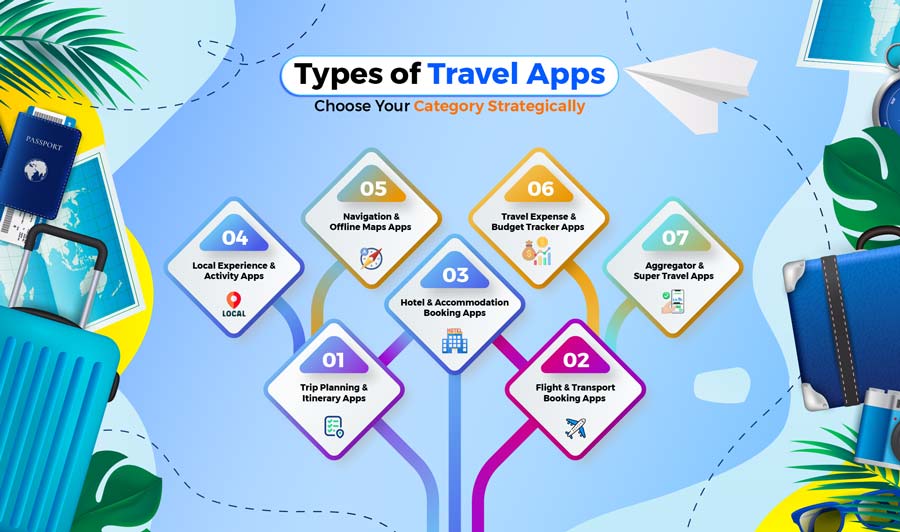
Before a single line of code is written, the most important question is: what problem are you solving for which traveler? There are seven major categories in the travel app ecosystem, each with distinct user expectations and monetization models.
- Trip Planning & Itinerary Apps These apps consolidate the entire journey flights, hotels, transfers, activities into a single visual timeline. Apps like TripIt and Wanderlog have proven this model. The key differentiator today is AI-powered itinerary generation that personalizes suggestions based on travel history, budget, and real-time availability.
- Flight & Transport Booking Apps The backbone of the OTA segment. Apps like Skyscanner and Expedia aggregate real-time fare data across hundreds of carriers. Building a competitive product in this space requires robust API integrations with systems like Amadeus, Sabre, or Travelport, plus predictive pricing features that convert browsing into booking.
- Hotel & Accommodation Booking Apps From luxury resorts to budget hostels to peer-to-peer homestays (the Airbnb model), accommodation apps rely heavily on trust mechanics verified reviews, photo-rich listings, and transparent cancellation policies to drive conversion.
- Local Experience & Activity Apps Post-pandemic travelers prioritize experiences over things. Apps that surface local tours, food tastings, adventure activities, and cultural workshops fill a fast-growing niche. GetYourGuide and Viator operate in this space with significant success.
- Navigation & Offline Maps Apps Essential for international travelers, particularly in areas with poor connectivity. Offline-capable navigation with multi-language support and POI (Point of Interest) discovery adds enormous utility.
- Travel Expense & Budget Tracker Apps Business travelers and long-term nomads need to track spend across multiple currencies, generate expense reports, and stay within per diems. This is an underserved niche with strong B2B monetization potential.
- Aggregator & Super Travel Apps The emerging trend: one app that does everything. Flights, hotels, car hire, travel insurance, currency exchange, and local experiences all in a single, seamless interface. Building a super app is more complex and expensive, but the user stickiness and lifetime value are dramatically higher.
Read More: Mobile App Development Trends in 2026 & 2027
Must-Have Features for a Competitive Travel App in 2026
The line between a good travel app and a great one is drawn by features that save time, build confidence, and create delight. Here's what every modern travel app needs divided by tier.
Core Features (Non-Negotiable)
- Smart Search with Filters: Real-time availability search with date flexibility, budget range, star rating, and traveler type filters. Speed matters: 53% of mobile users abandon an app that takes more than 3 seconds to load results.
- Secure Booking & Payment Gateway: Multi-currency support, integration with Stripe, PayPal, Razorpay, or regional gateways, plus EMI/BNPL (Buy Now, Pay Later) options that are increasingly expected by global users.
- User Profiles & Booking History: Personalized dashboards where users can manage upcoming trips, view past bookings, store travel documents, and track loyalty points.
- Push Notifications & Real-Time Alerts: Flight status updates, check-in reminders, price drop alerts, and gate change notifications delivered in real time.
- In-App Customer Support: Live chat, AI chatbots, and 24/7 support integration. Travelers encounter problems at 2 AM in foreign time zones; your app needs to be there.
- Multi-Language & Multi-Currency Support: Global apps serve global users. Localization is not an afterthought; it's a growth strategy.
- Offline Access: Downloaded itineraries, maps, and booking confirmations must be accessible without an internet connection.
Advanced Features (Competitive Differentiators)
- AI-Powered Personalization: Machine learning that analyzes past behavior to surface relevant destinations, deals, and experiences before the user searches for them.
- Augmented Reality (AR) Navigation: Point the phone camera at a street to see overlaid directions, restaurant ratings, or hotel proximity. AR features dramatically improve in-destination utility.
- Voice Search & Voice Booking: Conversational AI integration that allows users to search and book using natural language commands.
- Dynamic Pricing Engine: Show users personalized price predictions ("Book now — this flight is likely to rise 15% in 48 hours") to reduce decision paralysis and increase conversion.
- Social & Community Features: Travel is inherently social. In-app reviews, user-generated content, trip sharing, and travel community features increase engagement and reduce churn.
- Biometric Authentication: Face ID and fingerprint login for fast, secure account access and payment authorization.
- Carbon Footprint Tracker: A fast-growing expectation among eco-conscious travelers, particularly in European markets.
The Travel App Development Process: Step by S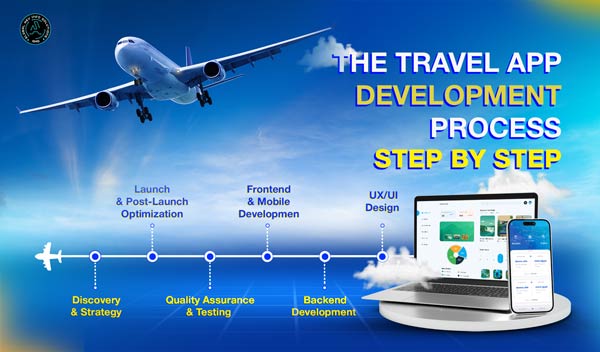
A professional travel app development company follows a structured process that reduces risk, controls costs, and delivers a product that works at scale.
1: Discovery & Strategy (2–4 Weeks)
This is where business goals become technical requirements. The development team conducts competitor analysis, user persona mapping, feature prioritization, and platform decisions (iOS, Android, or cross-platform). A detailed project roadmap and cost estimate emerge from this phase.
2: UX/UI Design (3–6 Weeks)
Travel apps live or die on their user experience. Wireframes are built first skeletal layouts that map user flows without visual distraction. High-fidelity UI mockups follow, incorporating brand identity, typography, color systems, and micro-interactions. Mobile-first design is the standard; every screen is built for touch before it's adapted for desktop.
3: Backend Development (6–12 Weeks)
The backend is the engine. Developers build the server architecture, database schema, API infrastructure, and third-party integrations. For travel apps, key integrations include:
- GDS (Global Distribution Systems): Amadeus, Sabre, Travelport for flights and hotels
- Maps & Navigation: Google Maps API, Mapbox
- Payments: Stripe, Braintree, regional gateways
- Communication: Twilio (SMS/WhatsApp), SendGrid (email), Firebase (push notifications)
- Analytics: Mixpanel, Firebase Analytics, Amplitude
4: Frontend & Mobile Development (6–12 Weeks)
The client-facing layer is built using modern frameworks. For cross-platform development, React Native and Flutter allow a single codebase to run on both iOS and Android, significantly reducing cost. For maximum performance, native Swift (iOS) or Kotlin (Android) development is preferred.
5: Quality Assurance & Testing (2–4 Weeks)
Travel apps must perform flawlessly under load thousands of simultaneous booking requests, payment processing under fluctuating network conditions, and data accuracy under real-time API changes. QA includes functional testing, performance testing, security testing, and device/OS compatibility testing across hundreds of configurations.
6: Launch & Post-Launch Optimization (Ongoing)
Launch day is not the finish line. The best travel app development services include post-launch analytics monitoring, crash reporting, A/B testing of key conversion flows, app store optimization (ASO), and regular feature updates driven by user feedback and behavioral data.
Mobile Responsive Website vs. Mobile App: Do You Need Both?
This is one of the most common questions asked of any travel mobile app development company. The answer, in most cases, is yes and here's why.
A mobile responsive website is your front door. It's indexed by Google, accessible without an app download, and essential for capturing users who are in the early discovery phase of trip planning. A well-built, mobile-first website drives organic traffic, supports SEO campaigns, and provides a frictionless entry point for first-time visitors.
A mobile app is your loyalty engine. App users spend 3x more time on average than mobile web users, convert at higher rates, have higher average order values, and are significantly more likely to return. Push notifications, offline access, and device integrations (camera, GPS, contacts) are only possible through a native or hybrid app.
The winning strategy for a travel brand in 2026 & 2027 is a unified website and mobile app development approach where both products share the same design system, content infrastructure, and API backend, ensuring consistency across every touchpoint in the customer journey.
Technology Stack for Modern Travel Apps
Choosing the right technology is a strategic decision that affects performance, scalability, cost, and the ability to hire developers who can support the product long-term.
|
Layer |
Recommended Technologies |
|
Frontend (Web) |
React.js, Next.js, Vue.js |
|
Mobile (Cross-Platform) |
React Native, Flutter |
|
Mobile (Native) |
Swift (iOS), Kotlin (Android) |
|
Backend |
Node.js, Python (Django/FastAPI), Ruby on Rails |
|
Database |
PostgreSQL, MongoDB, Redis |
|
Cloud Infrastructure |
AWS, Google Cloud Platform, Azure |
|
Real-Time Features |
WebSockets, Firebase, Socket.io |
|
AI/ML Layer |
TensorFlow, OpenAI API, custom recommendation engines |
|
DevOps |
Docker, Kubernetes, CI/CD pipelines |
How Much Does Travel App Development Cost in 2026 & 2027?
Cost is determined by four variables: feature complexity, platform choice (iOS, Android, or cross-platform), the geographic location of your development team, and the quality of UX/UI design.
|
App Type |
Estimated Cost Range |
Timeline |
|
MVP / Basic App (core booking features) |
$15,000 – $40,000 |
3–5 months |
|
Mid-Complexity App (advanced features, AI integration) |
$40,000 – $100,000 |
5–9 months |
|
Enterprise / Super App |
$100,000 – $300,000+ |
9–18 months |
|
Mobile Responsive Website (standalone) |
$5,000 – $25,000 |
1–3 months |
|
Website + App (combined build) |
$30,000 – $150,000 |
4–12 months |
Note: Development rates vary significantly by region. North American and Western European agencies typically charge $100–$200/hour. Eastern European teams average $40–$80/hour. South and Southeast Asian teams operate at $20–$50/hour with highly competitive quality.
The most cost-effective approach for most startups and growing travel businesses is a cross-platform MVP that validates core assumptions before a full-scale build, developed by a specialized travel app development company with domain expertise in GDS integrations and booking system architecture.
10 Best Practices for Travel Apps That Actually Retain Users
Building the app is half the battle. Building an app that users return to and pay with is the real win. Here are the practices that separate successful travel apps from abandoned ones.
- Onboard with value, not friction. Show users the best deal available to them before asking for an account. Let them browse first; capture the registration at the booking step.
- Personalize from session one. Ask three questions during onboarding (travel style, typical budget, preferred destinations) and immediately surface relevant content. Generic feeds lose users within 48 hours.
- Make Q4 your biggest push. The holiday travel season (October–December) drives a disproportionate volume of bookings globally. Seasonal campaigns, push notification sequences, and UI promotions should be planned months in advance.
- Design for low-bandwidth conditions. Significant travel app usage happens in airports, on trains, and in hotels with poor WiFi. Progressive loading, data compression, and offline-first design are non-negotiable.
- Build trust before asking for payment. Verified reviews, clear cancellation policies, transparent pricing (no surprise fees at checkout), and visible security badges directly impact conversion rates.
- Use deep linking aggressively. When a user clicks a promotional email about flights to Bali, they should land directly on the Bali flight search screen not the home screen. Every marketing touchpoint should link to a contextually relevant in-app destination.
- Reward loyalty with tangible value. Points programs, exclusive member pricing, and early access to deals are proven retention tools. Build the loyalty infrastructure into the app from day one.
- Localize completely, not partially. Currency, language, date format, measurement units, and customer support channels must all reflect the user's locale. Partial localization signals inauthenticity and reduces trust.
- Monitor and act on app store reviews. Negative reviews about specific bugs or missing features are a direct product roadmap. Responding publicly to reviews also signals to new users that the company is responsive and professional.
- Instrument every funnel step. If you can't measure where users drop off between search and booking confirmation, you can't improve it. Full analytics instrumentation from day one is essential.
Why Work with a Specialized Travel App Development Company?
Not all software development companies are equal when it comes to travel. The travel industry has unique technical requirements GDS API integrations, real-time inventory synchronization, dynamic pricing logic, and PCI-DSS compliance for payment processing that require domain experience, not just coding ability.
A specialized travel app development company brings:
- Pre-built integration experience with Amadeus, Sabre, and Travelport
- Familiarity with travel industry compliance and data security standards
- UI/UX patterns proven to convert travel-intent users into bookers
- A portfolio of live travel products with measurable business outcomes
- Post-launch support capacity for the time-sensitive, always-on nature of travel platforms
When evaluating partners for travel app development services, ask for specific travel industry case studies, integration experience, and post-launch performance data not just a portfolio of generic apps.
At Global Key Info Solutions, we specialize in end-to-end website and mobile app development for travel brands, hospitality operators, and tourism startups worldwide. Our team combines technical depth with travel industry knowledge to deliver digital products that drive direct bookings and build lasting customer relationships.
Ready to Build Your Travel App?
The digital traveler is already on their phone, searching for their next trip. The question is whether they find your platform — or a competitor's.
Global Key Info Solutions delivers full-cycle travel app development services, from discovery and design through development, launch, and growth optimization. We build mobile responsive websites, native and cross-platform mobile apps, and integrated website and mobile app ecosystems that drive real business outcomes for travel brands globally.
Get in touch today for a free consultation and project scoping call. Your competitive advantage in the travel market starts with the right development partner.






1 Comment
Roman Gardner
Very detailed travel app guide. Travel businesses increasingly rely on scalable React Native apps for seamless user experiences. Related read: https://mobisoftinfotech.com/resources/blog/react-native-app-development-partner-guide
Leave a comment